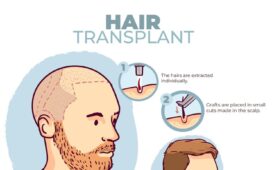

FUE became the dominant hair transplant method not because it was newer, but because it solved the one problem patients cared about most: the scar. The strip method that preceded it left a linear incision across the back of the scalp. FUE left nothing visible at most hairstyle lengths. That single difference changed who was a realistic candidate and moved the consultation age significantly younger.
FUE extracts follicles one at a time from the donor zone at the back and sides of the scalp, using a circular tool under a millimetre wide. Each extraction point heals as a tiny dot, leaving no linear incision in the donor area. That is the practical difference that expanded who hair transplants were actually possible for.
What Makes FUE Hair Transplant Different From Other Methods
There have been two main approaches to hair transplant surgery for decades. The older method, FUT, involves removing a strip of scalp from the donor area, which is then divided into individual hair units. FUE takes a different approach. Rather than removing a strip, each follicular unit is taken out one at a time using a small circular tool.
This single difference in technique produces meaningfully different outcomes in terms of scarring, recovery time, and how the donor area looks afterward.
Individual Extraction Process
In FUE, a tiny circular punch, less than one millimetre in diameter, is used to extract each follicular unit directly from the scalp. The extraction sites are so small that they heal as tiny round dots, each smaller than a pinhead. These heal within a few days and fade to the point where they are effectively invisible at most hair lengths.
No stitches are needed, and the donor area does not carry a continuous scar the way it does with the strip method.
Healing and Scar Profile
Because FUE creates many tiny individual healing points rather than a single long incision, the recovery profile is lighter than with FUT. Most patients return to desk-based work within five to seven days. The small circular marks in the donor zone fade within weeks and are invisible at any hairstyle above a very short clipper cut.
For patients who want to wear their hair short, including close-cropped and grade-one styles, this is a significant practical difference that the strip method cannot offer.
The Clinical Cases Where FUE Is the Recommended Method
FUE is not automatically the right choice for every hair loss patient. There are cases where FUT is a more appropriate method, particularly when a very high graft count is needed in a single session. But for most patients presenting at a consultation in their twenties, thirties, or early forties with mild to moderate hair loss, FUE is where the clinical assessment lands.
The cases below reflect where fue hair transplant is consistently recommended over other approaches:
- A patient who keeps their hair at short or medium length and wants to maintain that option after the procedure. The circular FUE scars are not visible at these lengths, whereas the linear FUT scar is visible if the hair is cut short.
- A patient who needs between 1,500 and 3,500 grafts to achieve their coverage goals, which is the range where FUE produces results comparable to FUT without the recovery trade-offs.
- A patient with an active lifestyle, someone who exercises regularly or returns to physical activity within a week of the procedure, who prefers the shorter restriction window that FUE offers compared to FUT.
- A younger patient whose hair loss is still progressing, making multiple future sessions likely over the coming years. FUE allows the donor zone to be used across more than one procedure without leaving a permanent visible scar that grows more prominent with each return visit.
- A patient where scalp laxity, meaning the degree to which the scalp skin can be stretched, is low. FUT requires enough laxity to close the strip incision neatly. FUE has no such requirement.
What a FUE Hair Transplant Procedure Involves Step by Step
Knowing what actually happens at a FUE procedure reduces the anxiety that most patients carry into their first consultation. The day is long but straightforward, and most patients report that it is considerably less intense than they expected.
Before the Procedure
The preparation stage happens at the consultation before the procedure day. It includes a scalp assessment to confirm loss stage, donor density, and graft count, a hairline design session where the planned result is mapped out, and a discussion of aftercare and activity restrictions.
The delhi hair treatment clinics consultation at Evoke covers all of this in a single appointment so that the procedure day itself is focused entirely on execution.
On Procedure Day
The procedure is done under local anaesthesia, which numbs both the donor and recipient areas. The patient is awake throughout and typically watches a film, listens to music, or rests during the session.
- The donor area at the back and sides of the scalp is trimmed short and numbed. Each follicular unit is then extracted individually using the circular punch device.
- Extracted grafts are stored in a specialised solution that keeps them viable while the recipient zone is prepared.
- The hairline and recipient area are mapped, small recipient channels are made by the surgeon, and grafts are placed into those channels at angles that replicate natural hair growth direction.
- Most FUE sessions take between six and ten hours depending on the graft count. Patients go home the same day.
Frequently Asked Questions
Is FUE suitable for women?
Yes. FUE is used for female hair loss as well as male, and it is particularly useful for women because it allows targeted extraction from specific donor zones without requiring the full back-of-head shave that FUT involves. Women with thinning at the frontal hairline or crown who have stable surrounding donor density are often good candidates for FUE.
How many FUE sessions does a typical patient need?
Most patients with mild to moderate hair loss complete their restoration goals in a single session. Patients with more advanced loss or those who want to add density over time may plan for a second session years later. The initial consultation maps the expected total graft requirement across the patient’s full lifetime so that donor follicles are allocated strategically rather than used entirely in one visit.
What does the shedding phase after FUE mean?
Between two and five weeks after the procedure, the transplanted hair sheds. This happens because the follicles cycle into a resting phase before beginning permanent growth. It is a normal part of the process and is not a sign that the transplant has failed. The follicle remains intact beneath the scalp surface and begins producing new, permanent growth from around month three or four onward.
How long before FUE results are fully visible?
The transplanted hair begins growing visibly from month three or four. The density improves progressively through months five to eight. The full result, where shaft calibre has stabilised and coverage is at its final state, is typically assessable between months ten and fourteen after the procedure.