

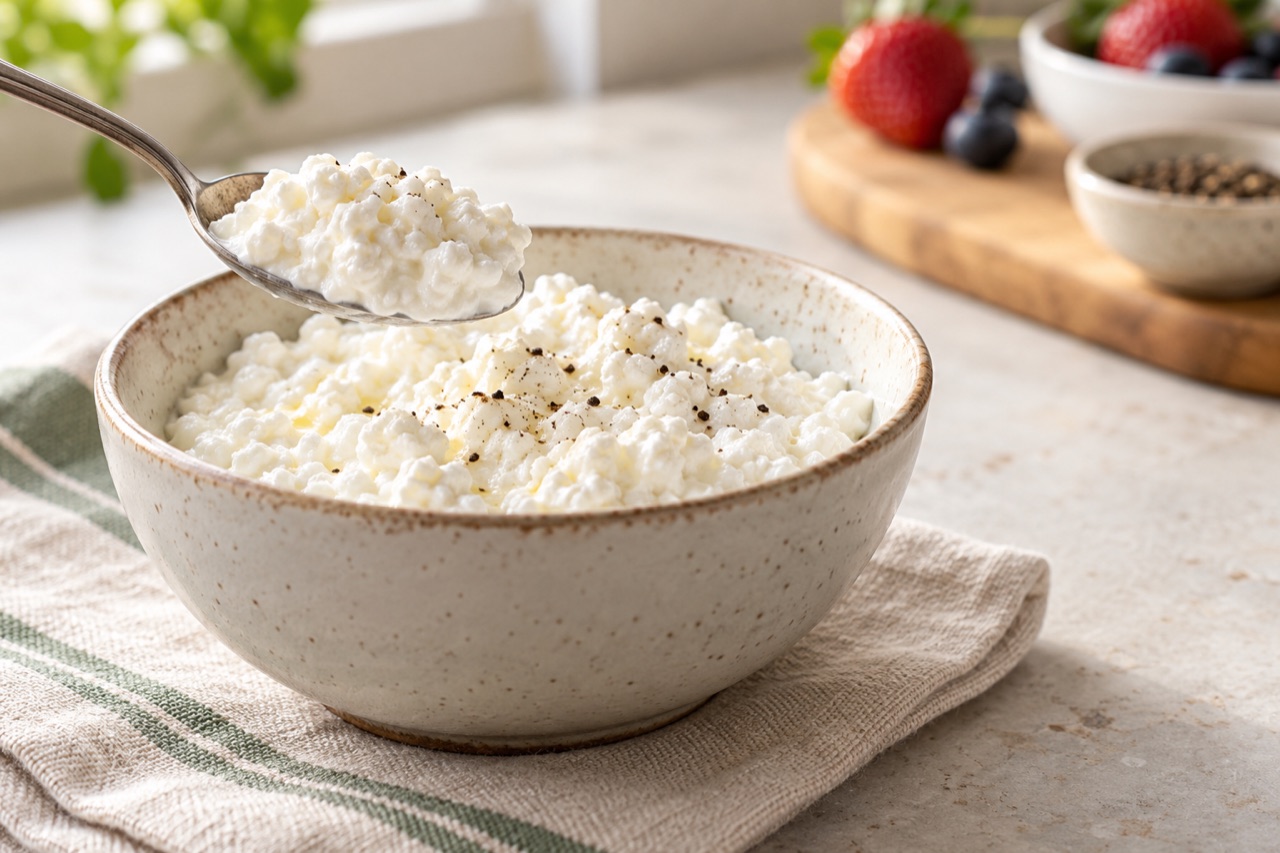

What does cottage cheese taste like? It tastes mild, milky, lightly tangy and a little salty. Its flavor is much gentler than sharp cheddar, feta or blue cheese. What surprises many first-time eaters is not the taste but the texture: soft, moist curds sit in a creamy dressing, so each spoonful can feel both lumpy and smooth.
The exact experience depends on the product. Small-curd cottage cheese feels more uniform, large-curd cottage cheese has more noticeable pieces, and a higher-fat version generally tastes richer than a fat-free one. Added fruit, herbs or seasonings can change the flavor completely.
How this guide was researched: We compared the FDA definition, USDA quality standards, university cheesemaking guidance and peer-reviewed sensory research, then reviewed public first-taste discussions and blind brand tests for recurring subjective reactions. Healthy B Daily did not conduct its own blind taste test, so no brand is declared “best” here.
Cottage cheese taste at a glance
| Characteristic | What to expect |
|---|---|
| Main flavor | Mild, fresh and milky |
| Tanginess | Lightly tangy rather than sharply sour |
| Saltiness | Usually noticeable, but it varies by brand |
| Texture | Soft, moist curds in a creamy dressing |
| Aroma | Fresh dairy with a gentle cultured smell |
| Strong or pungent? | Normally no |
USDA quality standards describe cottage cheese as having a mild, pleasing flavor similar to fresh whole milk or light cream, sometimes with the delicate flavor and aroma of a lactic culture. That is a useful baseline: plain cottage cheese should taste fresh and gently cultured, not aggressively sour, bitter or yeasty.
What does cottage cheese taste like? The closest comparison
If you have never eaten cottage cheese, imagine the mild dairy flavor of fresh mozzarella, the faint tang of plain yogurt, and the moisture of ricotta - but with soft, separate curds instead of a uniform texture. That comparison is imperfect, but it is more useful than simply saying it tastes “cheesy.”
Cottage cheese is best understood as two sensations in one spoonful:
- The curds provide the soft, tender or slightly springy pieces. Their flavor is usually very mild.
- The dressing supplies much of the creaminess, salt, moisture and cultured tang around those pieces.
This explains why people can agree that cottage cheese is mild yet have completely different reactions to it. The flavor may be gentle, while the contrast between wet dressing and distinct curds is impossible to ignore.
What does cottage cheese actually taste like?
Plain cottage cheese sits somewhere between fresh milk, plain yogurt and a very mild fresh cheese. It has a clean dairy flavor with a slight cultured tang. Salt is often more noticeable than acidity, although the balance differs among brands.
The curds themselves are relatively mild. Much of the richness, moisture and seasoning comes from the creamy liquid around them. This is why two tubs labeled “cottage cheese” can taste surprisingly different. One may be loose, creamy and salty; another may be firmer, drier and more tart.
Cottage cheese does not normally have the aged, nutty or pungent flavors associated with cheeses such as Parmesan, mature cheddar or blue cheese. If strong cheese is what you dislike, cottage cheese may still be approachable. If lumps are the problem, blending it can create a much smoother texture without substantially changing its flavor.
Why one brand can taste completely different from another
Brand differences are real, not just advertising. A sensory study published in the Journal of Dairy Science found that commercial cottage cheeses differed in cooked, milkfat, diacetyl and acetaldehyde flavor notes; saltiness; firmness; smoothness; tackiness; curd size; and adhesiveness. Consumers also split into preference groups: there was no single texture that pleased everyone.
In practical terms, these are the variables you notice:
| Variable | What it changes in the spoonful |
|---|---|
| Curd size | How obvious and chewable the pieces feel |
| Curd firmness | Whether the curds feel tender, bouncy, mealy or rubbery |
| Dressing amount | Whether the product seems thick and cohesive or loose and wet |
| Milkfat | Richness, mouth-coating creaminess and perceived sharpness |
| Salt | How savory the cheese tastes and how strongly other flavors register |
| Culture and acidity | The intensity and character of the tang |
| Stabilizers or starches | The thickness and consistency of the dressing; effects vary by formula |
This is why disliking one tub does not necessarily mean you dislike cottage cheese as a category. It may mean you dislike that product’s curd firmness, salt level or liquid-to-curd ratio.
What the ingredient list can - and cannot - tell you
A short ingredient list is easy to understand, but it does not guarantee that you will prefer the product. Gums and starches are sometimes used to control thickness and keep the dressing consistent. Their presence does not automatically make a cottage cheese unsafe or “fake.” Taste tests frequently show strong brand preferences, but those tests are subjective and cannot prove that a particular ingredient caused the result.
The label is most useful for comparing milkfat, sodium, lactose-free labeling and ingredients that matter to your dietary needs. Your own reaction to the curd and dressing is still the deciding factor.
How the making process creates the taste
Cottage cheese is a fresh, uncured cheese rather than an aged cheese. Under the U.S. standard of identity, cottage cheese is dry curd mixed with a pasteurized creaming mixture and contains at least 4% milkfat. Products sold as low-fat or nonfat cottage cheese follow different compositional rules and formulations.
The basic process also explains the eating experience:
- Milk is acidified or cultured. Milk proteins gather into a soft gel while liquid whey separates. Culture can contribute gentle lactic and buttery aroma notes.
- The gel is cut into curds. Smaller cuts make smaller pieces; larger cuts preserve larger pieces.
- The curds are heated, drained and washed. Heating firms them. Washing removes whey and some acid, which helps explain why cottage cheese is usually milder than people expect.
- Cream or another dressing is added. This controls much of the final richness, moisture and cohesion.
- Salt and optional ingredients finish the product. Even a modest difference in salt or dressing can change the overall impression.
The University of Kentucky’s cottage-cheese instructions note that washing the curd removes considerable acid so it will not taste as sour, while excessive heating can squeeze out too much whey and produce dry or rubbery curds. Those two steps help explain why acidity and texture vary even when the ingredient lists look similar.
What is the texture of cottage cheese?
Texture is the defining feature of cottage cheese. The product contains individual curds surrounded by a moist dressing. Depending on the type, those curds can feel soft and delicate, slightly springy, or more clearly separated.
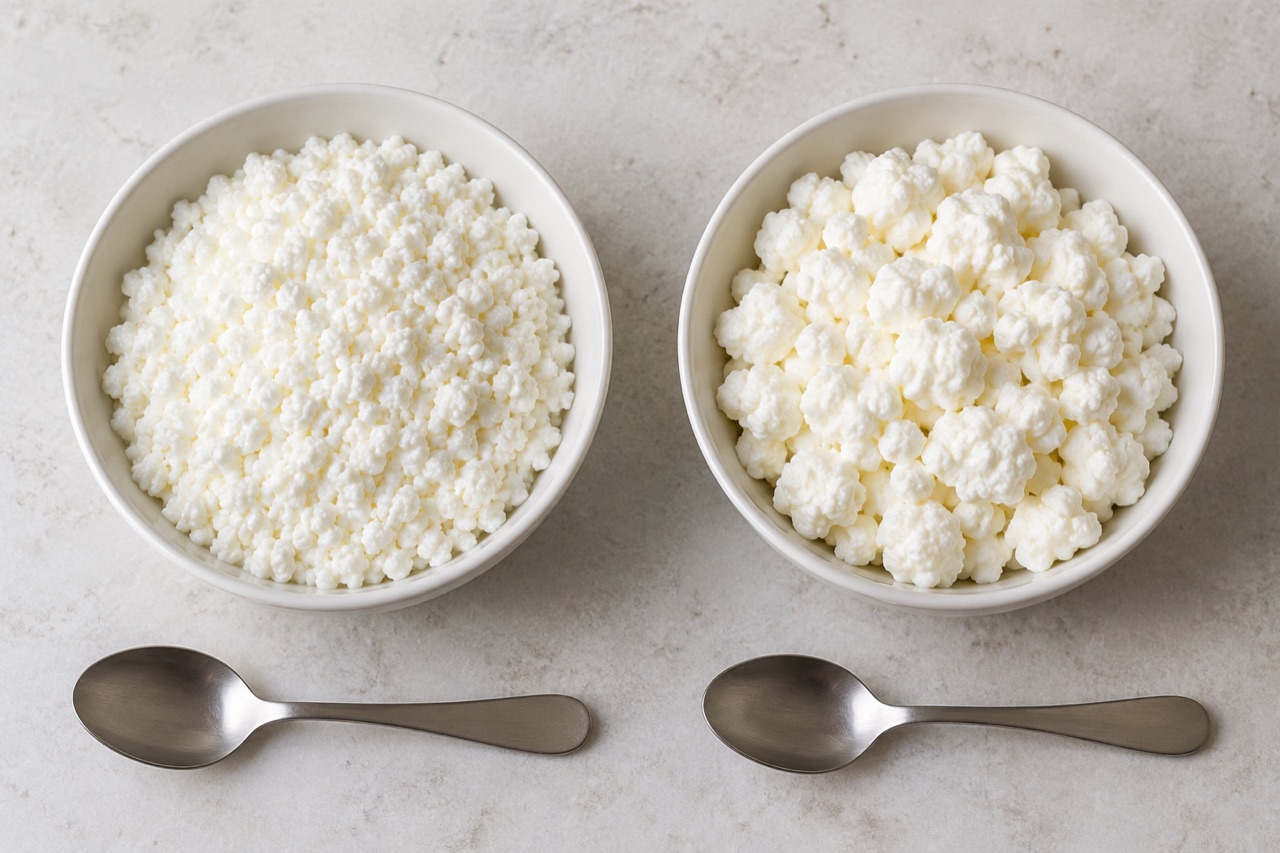
Small curds feel more uniform, while large curds create more distinct pieces in each bite.
Small-curd cottage cheese
Small-curd cottage cheese has finer pieces that distribute more evenly across a spoonful. It can feel more uniform because the curds and dressing combine more readily. USDA specifications describe small curds as approximately 1/4 inch or less.
Small curd is not automatically smoother, however. Firm curds in a thin dressing can still feel grainy or busy. It is usually the better starting experiment for someone who wants less obvious individual pieces, not a guarantee against texture.
Large-curd cottage cheese
Large-curd cottage cheese contains bigger, more distinct pieces - about 3/8 inch or more under USDA quality specifications. The individual curds are easier to feel and may seem softer or more substantial when chewed. People who enjoy a clear contrast between curds and cream may prefer it.
Curd size alone does not determine flavor. Brand formulation, dressing, salt and fat may have a larger effect than the words “small curd” or “large curd” on the front of the tub.
Blended cottage cheese
Blending cottage cheese turns it into a smoother spread, dip or sauce base. The mild tang remains, but the familiar curds disappear. This can be useful if you like its flavor or want a versatile dairy food but dislike the original texture.
Is cottage cheese creamy, chunky, grainy or rubbery?
A good-quality cottage cheese should be creamy around the curds, with pieces that are tender enough to chew easily. USDA quality language calls the desired body “smooth and velvety” and specifically treats mealy, crumbly, pasty, sticky, mushy, watery, rubbery and slimy textures as defects.
That does not mean every shopper will describe the same tub in the same way. Sensory research shows that firmness, smoothness, curd size and the amount of free dressing all influence preference. One person’s pleasantly tender curd can be another person’s unwanted lump.
If a product feels:
- Too watery: try a thicker brand or drain a serving briefly; do not drain the whole tub unless you will use it promptly.
- Too firm or rubbery: try a higher-fat or differently cultured product rather than assuming all cottage cheese is the same.
- Too grainy: blend a portion until smooth or try a whipped product.
- Too bland: add one familiar sweet or savory flavor after tasting it plain.
Does fat level change the taste?
Yes. Fat level can change both richness and mouthfeel.
- Full-fat or 4% cottage cheese usually tastes rounder and creamier. USDA specifications define creamed cottage cheese as containing at least 4% milkfat.
- Low-fat cottage cheese can still be creamy, but it may taste lighter, saltier or slightly more tangy depending on its formulation.
- Fat-free cottage cheese often has a leaner mouthfeel. Some products use stabilizers or other ingredients to maintain body, so the ingredient list is worth checking.
- Dry-curd cottage cheese contains little dressing and tastes drier and less creamy than the familiar tub-style product.
Fat percentage does not tell you everything. Sodium, cultures, added cream and stabilizers also differ among products. Compare the Nutrition Facts label and ingredient list when choosing between brands.
Does cottage cheese taste sour?
Fresh cottage cheese has a light cultured tang, but it should not taste sharply or unpleasantly sour. A gentle acidity is part of its normal flavor. Strong sourness, bitterness, a yeasty flavor, visible mold or an unusual odor can indicate that the product is no longer good to eat.
Do not taste cottage cheese to test whether a questionable tub is safe. If it has mold, discoloration, a damaged or swollen package, or an odor that seems wrong, discard it. Cottage cheese is a soft, high-moisture cheese and should remain refrigerated.
USDA storage guidance gives opened cottage cheese about one week in a refrigerator kept at 40°F (4°C) or below. Follow the package instructions as well, use a clean spoon, and return the container to the refrigerator promptly.
What does cottage cheese smell like?
Fresh cottage cheese should have a mild dairy aroma with a gentle cultured note. It may smell slightly tangy, but the smell should not be harsh, rotten, unusually yeasty or strongly fermented.
Some liquid separation is normal. Whey can collect on the surface while the tub sits in the refrigerator, and it can usually be stirred back into the curds. Separation alone is not the same as spoilage, but combine what you see with the product’s age, refrigeration history, package condition and odor.
Cottage cheese compared with similar foods
| Food | Flavor compared with cottage cheese | Texture compared with cottage cheese |
|---|---|---|
| Ricotta | Mild and slightly sweet, usually less tangy | Finer, drier and more grain-like |
| Plain Greek yogurt | Usually tangier | Smooth and uniform |
| Cream cheese | Richer and denser, with mild tang | Completely smooth and spreadable |
| Feta | Saltier and considerably sharper | Firmer and more crumbly |
| Fresh mozzarella | Mild and milky, with less tang | Smooth, elastic and sliceable |
These comparisons are approximate because brands, fat levels and recipes vary. Cottage cheese is closest to ricotta in appearance, but it is usually wetter, saltier and more visibly curded. Greek yogurt is a useful comparison for acidity, although it does not have separate curds.
How to try cottage cheese for the first time
Start with a small serving rather than building an entire meal around an unfamiliar food. There is no universal “beginner” product, so choose based on what worries you most.
| If your main concern is… | A sensible first experiment |
|---|---|
| Visible or noticeable lumps | Small-curd, whipped or home-blended cottage cheese |
| A thin, wet texture | A thicker product with less free dressing |
| Sourness | A full-fat product described as mild or creamy |
| Blandness | Plain cottage cheese plus one familiar savory seasoning |
| Sweet-versus-savory uncertainty | Divide one serving and try fruit on one half, pepper or herbs on the other |
| Lactose | A product explicitly labeled lactose-free; “cultured” does not mean lactose-free |
| Sodium | Compare sodium per serving on Nutrition Facts labels instead of relying on front-label wording |
Try it chilled and plain first so you know its baseline flavor. Then add one familiar ingredient rather than several at once.
A three-spoon taste test that tells you more than one bite
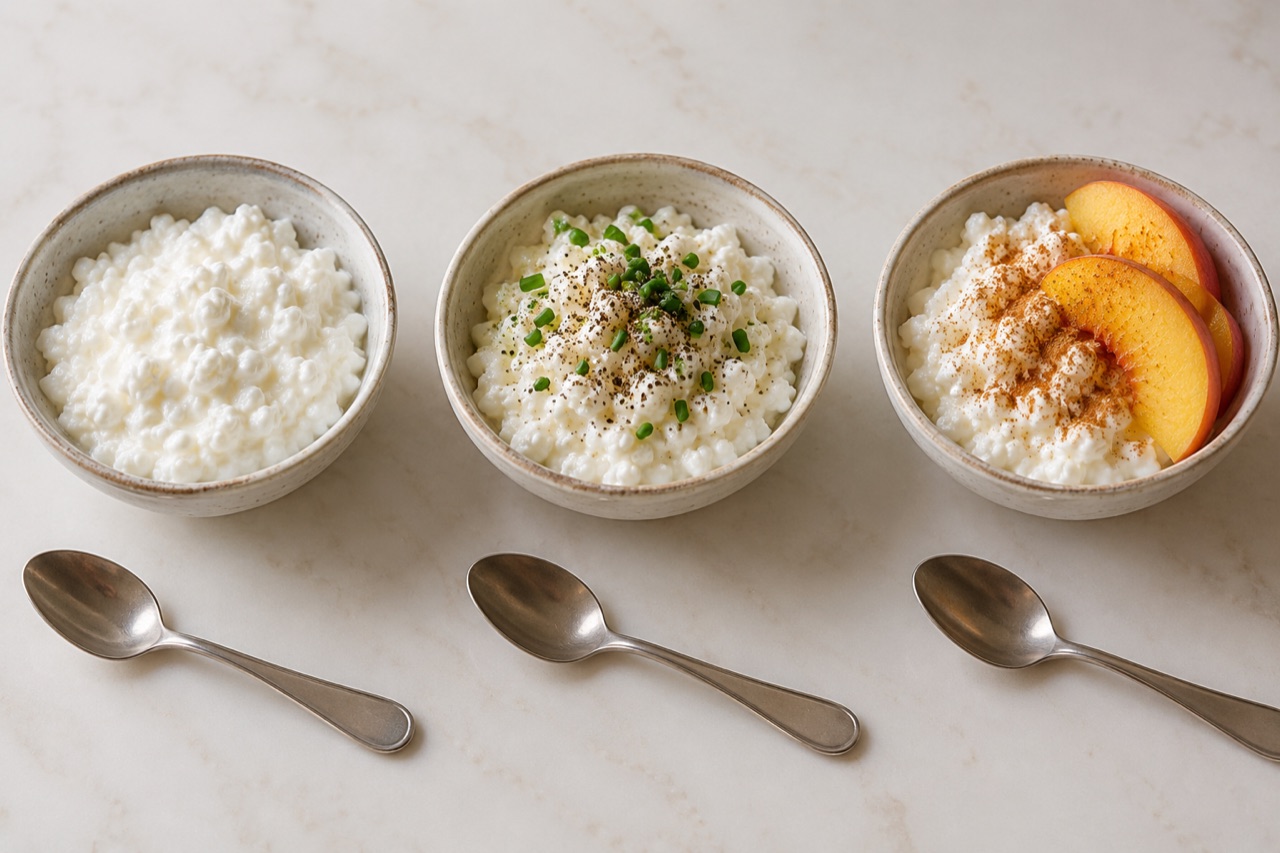
Trying cottage cheese plain, savory and sweet helps separate your reaction to its flavor from your reaction to its texture.
- Stir the tub gently so the dressing is distributed, then place a small portion in a separate bowl.
- Taste one spoonful plain. Notice sweetness, salt, acidity and how much liquid surrounds the curds.
- Taste one spoonful with a familiar savory addition, such as black pepper, herbs or tomato.
- Taste one spoonful with a familiar sweet addition, such as peach, berries or cinnamon.
This is not a formal sensory test. It is simply a low-waste way to determine whether you dislike the base flavor, the curd texture, or only the way it was served.
If you prefer sweet flavors
- Add sliced peaches, berries, banana or pineapple.
- Stir in cinnamon or a small amount of honey.
- Pair it with oats, chopped nuts or seeds if those foods are safe for you.
- Blend it with fruit for a smoother bowl.
If you prefer savory flavors
- Add black pepper, chopped herbs or a little olive oil.
- Serve it with cucumber, tomato or roasted vegetables.
- Spoon it onto toast or whole-grain crackers.
- Blend it with herbs and lemon for a dip.
- Add a small portion to scrambled eggs, pasta sauce or a baked dish.
These are serving ideas, not rules. Cottage cheese can be one component of a snack or meal alongside foods you already enjoy. The Healthy Snacks guide offers flexible ways to combine protein foods, produce, grains and fats without treating every snack as a nutrition calculation.
What real eaters repeatedly say about the taste
Public comments are not controlled research, and they should not be treated as proof that one brand, fat level or serving method is best. They are useful here because the search question is subjective: people want to know what the first bite may feel like.
Across Reddit discussions from people trying cottage cheese for the first time, a blind YouTube brand tasting, and published blind taste tests, five themes recur:
- Texture divides people more than flavor. Many hesitant eaters expect a strong cheese taste but describe the actual flavor as mild; the curds remain the deciding issue.
- Brand changes the experience substantially. Commenters repeatedly report liking one brand and rejecting another because of wetness, curd firmness or tang.
- Higher-fat versions are often perceived as richer and gentler. That is a preference pattern, not a guarantee; some people still prefer a leaner, tangier product.
- Blending is the common workaround for “lump anxiety.” It removes the curd contrast while retaining the mild cultured flavor.
- Both sweet and savory pairings work. Fruit is common, but pepper, herbs, tomatoes, chili crisp and toast appear just as often.
The useful conclusion is not that the internet has chosen a winning brand. It is that a first trial should be small and diagnostic. If the flavor is acceptable but the texture is not, change the curd style or blend it. If the texture is acceptable but it tastes flat, change the pairing. If it tastes unusually harsh or wrong, do not force yourself to eat it - and check freshness before trying another product.
How to make cottage cheese taste better without hiding it completely
If plain cottage cheese feels bland, work with its mildness rather than covering it with many ingredients. Salt is already present in many products, so taste it before adding more.
For a savory bowl, try one aromatic ingredient, one crisp ingredient and one seasoning. Examples include cucumber with dill and pepper, tomato with basil, or grated carrot with herbs. For a sweet bowl, pair one fruit with cinnamon, nuts or seeds.
Temperature also matters. Very cold cottage cheese feels firmer and its aroma is muted. Letting a portion sit for a few minutes can make it taste creamier, but do not leave the container unrefrigerated for an extended period.
Blending is the most effective adjustment for people who enjoy mild dairy flavors but dislike curds. Use the blended cheese immediately or return it promptly to the refrigerator in a covered container.
Is cottage cheese a healthy choice?
Cottage cheese can fit into a balanced eating pattern, but no single food determines whether a diet is healthy. Products differ in protein, fat, sodium, added ingredients and serving size. Some varieties are particularly high in sodium, while others are formulated with less sodium or different fat levels.
Use the Nutrition Facts label to compare products based on what matters to you. Someone who has been advised to limit sodium may choose differently from someone who needs an energy-dense snack. People with a milk allergy must avoid cottage cheese unless their clinician has provided different guidance. Lactose tolerance also varies, and lactose-free versions may be available.
For a broader framework, see Healthy Eating Basics and the guide to building a balanced plate. Both focus on overall eating patterns rather than labeling an individual food as universally good or bad.
Frequently asked questions
Does cottage cheese taste like regular cheese?
Only slightly. It has a mild fresh-dairy flavor rather than the aged, sharp or pungent taste associated with many block cheeses. Its soft curds and creamy dressing also make the texture very different.
Does cottage cheese taste like yogurt?
Both can have a cultured tang, but cottage cheese is usually saltier and less uniformly sour. Yogurt is smooth, while cottage cheese contains distinct curds.
Does cottage cheese taste like sour cream?
It can share a mild cultured tang with sour cream, but cottage cheese is usually less sharply acidic and has separate curds. When blended, the resemblance becomes stronger, although blended cottage cheese is generally lighter and less uniformly rich.
Does cottage cheese taste like ricotta?
They are both mild fresh cheeses, but ricotta is usually finer, drier and slightly sweeter. Cottage cheese is wetter, often saltier and has more obvious curds.
Does cottage cheese taste like spoiled milk?
No. Fresh cottage cheese should taste clean, milky, mildly salty and only gently acidic. A sharply sour, bitter, yeasty, rancid or otherwise abnormal taste is not the flavor you should expect. Do not keep tasting a questionable product to decide whether it is safe.
Is cottage cheese supposed to taste salty?
A light savory saltiness is normal, but intensity varies widely. Compare sodium on Nutrition Facts labels if you prefer a less salty product; a “low-fat” label does not tell you how salty it will taste.
Does full-fat cottage cheese taste better?
Full-fat cottage cheese generally has a richer, rounder mouthfeel, and many first-time eaters find that pleasant. “Better” is subjective, however. Some people prefer the brighter tang or firmer body of lower-fat products.
Which cottage cheese is best for beginners?
A small-curd, full-fat variety is a reasonable first experiment for someone who wants richer dressing and less prominent individual pieces. If any curd texture is the obstacle, choose whipped cottage cheese or blend a small portion. Buy the smallest container available because brand differences are meaningful.
Can I blend cottage cheese to remove the lumps?
Yes. Blending creates a smooth consistency suitable for dips, spreads and sauces. Keep it refrigerated and follow the storage instructions on the package.
Is cottage cheese supposed to have liquid on top?
A small amount of separated whey can be normal and may be stirred back in. Discard the product if separation appears alongside mold, discoloration, package swelling, an abnormal smell or other signs of spoilage.
How long does cottage cheese last after opening?
USDA guidance recommends about one week in the refrigerator at 40°F (4°C) or below. Follow the label and discard it sooner if it develops signs of spoilage or was not kept cold.
Bottom line: what does cottage cheese taste like?
Cottage cheese tastes mild, milky, lightly tangy and somewhat salty. The curds create its distinctive texture, but curd size, fat level and added cream can make one product feel very different from another. If you are unsure about it, begin with a small-curd variety, taste a spoonful plain, and then try it with one familiar sweet or savory ingredient.
Sources
- Electronic Code of Federal Regulations: 21 CFR § 133.128, Cottage cheese
- USDA Agricultural Marketing Service: Cottage Cheese Commodity Specification
- 7 CFR § 58.527: Cottage cheese flavor, body, texture and appearance requirements
- Journal of Dairy Science: Consumer preferences and sensory characteristics of cottage cheese
- University of Kentucky Cooperative Extension: Making Cottage Cheese at Home
- USDA Food Safety and Inspection Service: Refrigerated storage guidance for dairy products
- FoodSafety.gov: FoodKeeper
Public taste research used for the subjective section
- Reddit r/Cheese: first-time taste and texture discussion
- Reddit r/NoStupidQuestions: “What does cottage cheese taste like?”
- YouTube: blind cottage-cheese brand taste test
- Delish: seven-brand blind taste test and methodology
Public comments and taste tests informed only the clearly labeled anecdotal section. Regulatory, manufacturing, quality and storage statements are based on the government, university and peer-reviewed sources above.