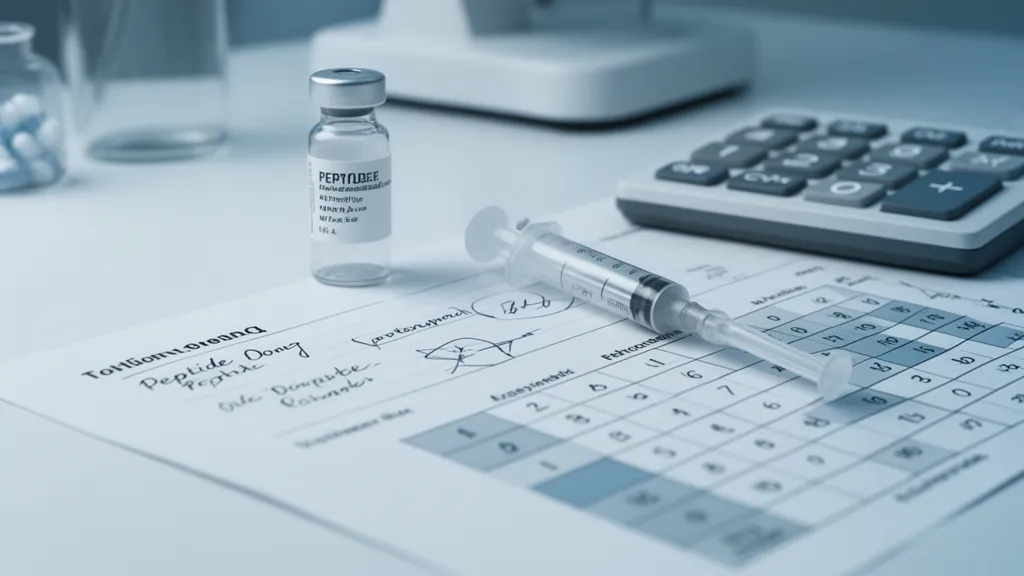
Calculating peptide concentration may appear complicated at first, especially when different peptide quantities, reconstitution volumes, and dosage requirements are involved. Fortunately, understanding a few basic principles makes the process much easier. Accurate calculations are essential for maintaining consistency during peptide preparation, and using a reliable peptide calculator helps reduce manual errors while saving valuable time.
Peptides are commonly supplied in lyophilized form and require reconstitution before they can be measured accurately. Once a peptide has been mixed with the appropriate amount of bacteriostatic water, the resulting concentration determines how much solution corresponds to a desired dosage. OZPEP provides a convenient peptide calculator at https://ozpep.com/peptide-calculator/ that helps simplify these calculations and supports accurate concentration measurements for research preparation.
What Is Peptide Concentration?
Peptide concentration refers to the amount of peptide contained within a specific volume of liquid after reconstitution. This concentration becomes the basis for every dosage calculation and plays an important role in maintaining consistency throughout research preparation.
Several factors influence peptide concentration, including:
- The total amount of peptide contained in the vial.
- The volume of bacteriostatic water added during reconstitution.
- The desired dosage for each measurement.
Once these values are known, calculating the appropriate volume becomes much more straightforward.
Understanding concentration is important because changing the amount of liquid used during reconstitution directly affects the strength of the final solution.
How Dilution Volume Affects Concentration
One of the easiest concepts to understand is the relationship between dilution volume and concentration. When more liquid is added to the peptide vial, the solution becomes less concentrated. Conversely, using less liquid creates a stronger concentration.
This relationship allows researchers to prepare solutions that match their intended measurement requirements while maintaining consistency across multiple preparations.
Accurate recording of the reconstitution volume is essential because even small differences can significantly change the resulting concentration.
Understanding Peptide Dosage Calculations
After determining the concentration, the next step is calculating the volume required for a specific dosage. Rather than relying on manual mathematical formulas, many researchers choose digital calculators that instantly determine the correct values.
The calculation process generally involves four simple steps:
- Confirm the peptide quantity.
- Enter the total reconstitution volume.
- Select the desired dosage.
- Review the calculated concentration and required solution volume.
Following these steps helps ensure calculations remain accurate while reducing unnecessary complexity.
Why Accuracy Matters
Accurate peptide calculations are important because consistency depends on reliable concentration measurements. Incorrect values may affect preparation quality and require calculations to be repeated.
Maintaining precise calculations offers several advantages:
- Consistent concentration across preparations.
- Improved measurement accuracy.
- Reduced calculation errors.
- Greater efficiency during preparation.
- Easier documentation for future reference.
Even small mathematical mistakes can alter concentration values, making careful calculations an important part of every preparation process.
Common Mistakes During Peptide Calculations
Although peptide calculations are relatively straightforward, several common mistakes can produce inaccurate results.
These include:
- Entering the wrong peptide quantity.
- Using incorrect units of measurement.
- Recording an inaccurate dilution volume.
- Misplacing decimal points.
- Forgetting to verify calculations before preparation.
Many of these issues occur during manual calculations rather than during data entry. Taking time to double-check every value before confirming the calculation helps improve overall accuracy.
How a Peptide Calculator Simplifies the Process
A peptide calculator eliminates much of the manual work involved in concentration calculations. Instead of performing several mathematical conversions by hand, users simply enter the required information and receive immediate results.
The calculator automatically processes the relationship between peptide quantity, dilution volume, and target dosage, producing clear concentration values that are easy to interpret.
This simplified approach reduces repetitive calculations while allowing users to make adjustments quickly whenever preparation requirements change.
Benefits of Using a Digital Calculation Tool
Modern peptide calculators provide several practical benefits for researchers preparing peptide solutions.
Some of the most valuable advantages include:
- Faster calculation times.
- Improved mathematical accuracy.
- Consistent concentration calculations.
- Simple and user-friendly operation.
- Reduced likelihood of manual calculation errors.
- Better preparation efficiency.
These benefits make digital calculators useful tools for routine peptide preparation involving different vial sizes and dosage requirements.
Building Confidence Through Consistent Calculations
Confidence in peptide preparation comes from understanding the calculation process and using reliable tools. By learning how concentration, dilution volume, and dosage interact, researchers can approach each preparation with greater accuracy and consistency.
Carefully reviewing all entered values before finalizing calculations further improves reliability and helps establish standardized preparation methods.
Conclusion
Understanding peptide concentration and dosage calculations does not have to be difficult. Once the relationship between peptide quantity, reconstitution volume, and desired dosage becomes clear, preparing accurate calculations is much simpler. Digital peptide calculators streamline this process by reducing manual arithmetic, improving consistency, and minimizing common calculation errors.
By combining a solid understanding of concentration principles with a dependable calculation tool, researchers can perform peptide preparation more efficiently while supporting accurate and repeatable research workflows.