

Disclaimer: This guide is for educational purposes and is designed for generally healthy adults who are new to exercise. It is not medical advice or a rehabilitation program. If you have an injury, unexplained symptoms, a medical condition that affects exercise, are pregnant or recently postpartum, or have recently had surgery, speak with an appropriate healthcare professional before starting.
In fact, you do not need a gym, pull-up bar or impressive starting strength to begin calisthenics. For that reason, this 30-day beginner plan uses simple bodyweight movements, easier exercise variations and scheduled recovery to help you learn the fundamentals without trying to progress too quickly. In practice, you will train strength three days most weeks, use walking or mobility on lighter days, and rest regularly. If a week still feels challenging, repeat it instead of forcing yourself forward.
Table of Contents
- What Is Included in This 30-Day Calisthenics Plan?
- Is This Beginner Calisthenics Plan Right for You?
- What Do You Need Before Starting?
- How to Warm Up for Calisthenics
- Seven Basic Calisthenics Exercises for Beginners
- How to Choose the Right Difficulty
- The Complete 30-Day Calisthenics Workout Plan
- Sets, Repetitions and Rest
- What If the Plan Is Too Difficult?
- How to Cool Down
- What Results Can You Expect?
- Can Calisthenics Help With Weight Loss?
- Calisthenics vs Gym
- Women, Pregnancy and Different Ages
- Frequently Asked Questions
- What to Do After 30 Days
What Is Included in This 30-Day Calisthenics Plan?
In short, this is a basic calisthenics workout built around movements that complete beginners can actually practice.
The plan includes:
- Three strength sessions during most weeks
- Light walking and mobility days
- Planned recovery days
- Beginner-friendly exercise variations
- Gradual progression rather than daily intensity increases
- 15-30 minute workouts
- No gym membership
- No pull-up bar
- No unsafe improvised equipment
This is an introductory whole-body movement plan, not a completely balanced long-term strength program. However, it does not contain a true pulling exercise because safe beginner pulling movements normally require suitable equipment. After the first month, add an appropriately anchored resistance-band row or a supported gym row.
Plan at a glance
| Week | Primary goal | Workout length | Difficulty |
|---|---|---|---|
| Week 1 | Learn the movements | 15-20 minutes | Introductory and self-scaled |
| Week 2 | Build consistency | About 20 minutes | Introductory |
| Week 3 | Add repetitions or sets | 20-25 minutes | Gradually progressive |
| Week 4 | Improve control and endurance | 25-30 minutes | Individually adjusted |
What exactly is calisthenics?
In other words, calisthenics is resistance training in which your body provides much or all of the resistance. For example, squats, push-ups, lunges, planks and similar movements are common examples.
However, that does not mean calisthenics must involve handstands, muscle-ups or dramatic outdoor-bar skills. In fact, those are advanced expressions of bodyweight training.
For instance, a beginner can start by sitting down to a chair under control, pushing away from a wall and learning to stabilize the trunk during a bird dog.
Bodyweight calisthenics counts as muscle-strengthening activity under U.S. physical-activity guidance. In addition, adults are generally advised to perform muscle-strengthening activity involving the major muscle groups on at least two days each week, alongside aerobic activity.
This plan uses three short strength sessions because that creates frequent opportunities to practice without making every day a hard workout.
Is This Beginner Calisthenics Plan Right for You?
This plan may suit you if…
You may be a good fit for this routine if:
- New to structured strength exercise
- Prefer to work out at home
- Cannot yet perform a standard floor push-up
- Feel overwhelmed by complicated fitness programs
- Want to learn basic bodyweight movements before progressing
- Can perform normal everyday movement without significant or unexplained pain
- Would rather build consistency than complete an extreme 30-day challenge
Ultimately, your current ability matters more than what you think a “beginner” should be able to do.
For example, someone who can perform three floor push-ups and someone who currently needs wall push-ups can both begin calisthenics. Instead, they simply start at different variations.
Speak with a healthcare professional first if…
Get individualized advice before following a generic program if you have:
- A current injury
- Recent surgery
- Unexplained chest pain
- Unexplained fainting or severe dizziness
- A medical condition that affects exercise tolerance
- Significant joint or movement problems
- Pregnancy-related exercise concerns
- Recently given birth
- Recently had a C-section
- Been specifically advised to restrict activity
Stop exercising immediately if you develop new chest pain or pressure, fainting, or severe or unexplained shortness of breath. If symptoms are sudden or severe, or occur with dizziness, sweating or nausea, seek urgent medical assistance. See the American Heart Association warning signs.
What Do You Need Before Starting?
For example, one advantage of calisthenics at home is that the starting setup can be extremely simple.
You need:
- Enough clear floor space to lie down
- A secure wall
- A sturdy chair that does not roll
- Comfortable clothing
- Water
- An optional exercise mat
- A phone timer or clock if you want to time your rests
You do not need to buy a pull-up bar, weighted vest, parallettes, gymnastics rings or an expensive calisthenics app before completing your first workout.
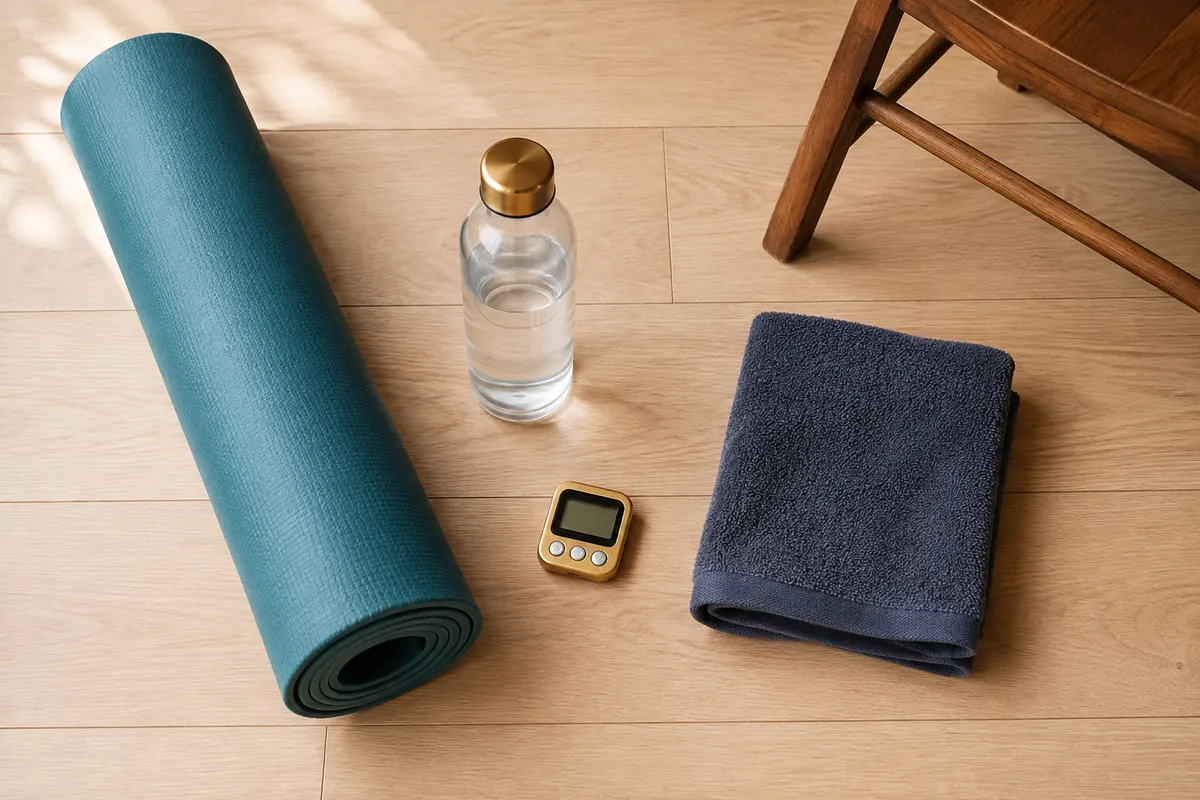
Exercise illustrations were created with AI and checked against the written movement instructions. In other words, they are visual aids, not individualized coaching.
A safety note about home equipment
Instead, use purpose-built, securely anchored equipment rather than dining tables, unstable chairs, doorframes or furniture as makeshift rowing or hanging stations.
A beginner program does need pulling exercises eventually, but a broken table is not a progression strategy.
This first month therefore focuses on movements that can be performed safely with the floor, wall and a stable chair. Afterward, a resistance band and an appropriate manufacturer-recommended anchoring setup can make pulling exercises much easier to add safely.
How to Warm Up for a Calisthenics Workout
In other words, a warm-up should make the upcoming workout feel easier. However, it should not become a workout of its own.
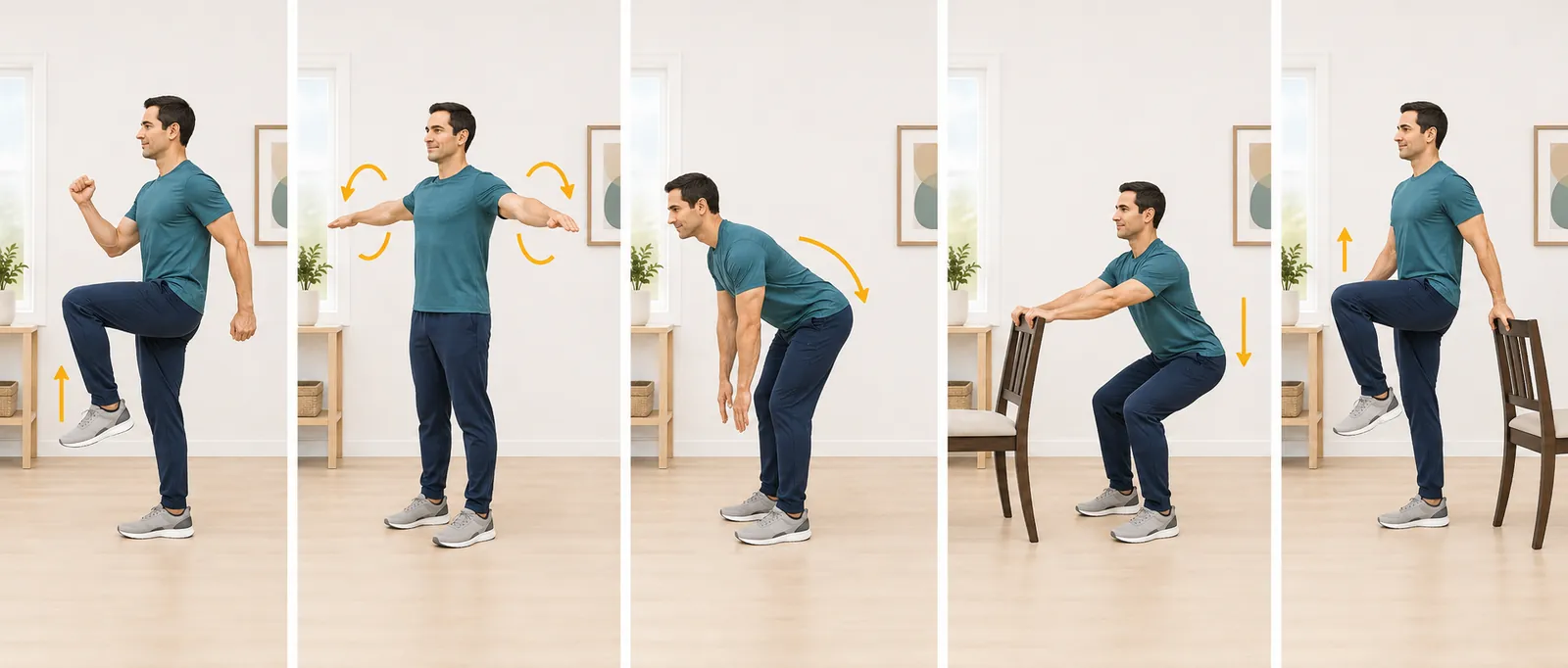
Spend about five minutes moving gently.
1. Easy marching in place
March comfortably for about 45-60 seconds.
Then, let your arms move naturally and gradually increase your pace.
2. Shoulder circles
Perform 5-10 slow circles forward, then 5-10 backward.
Avoid forcing an uncomfortable range.
3. Hip hinges
Place your hands on your hips and gently push your hips backward while keeping your torso controlled.
Perform 6-10 repetitions.
4. Supported bodyweight squats
Hold the back of a stable chair if necessary.
Perform 5-8 easy repetitions using a comfortable depth.
5. Alternating knee raises
Raise one knee at a time while standing tall.
Use the wall or chair for balance if needed.
Continue for about 30-45 seconds.
Finally, by the end of the warm-up you should feel warmer and more prepared, not exhausted.
Seven Basic Calisthenics Exercises for Beginners
These seven movements create the exercise library for your first month.
You do not need to master the hardest version of any movement. Instead, your goal is to find the version that lets you move under control.
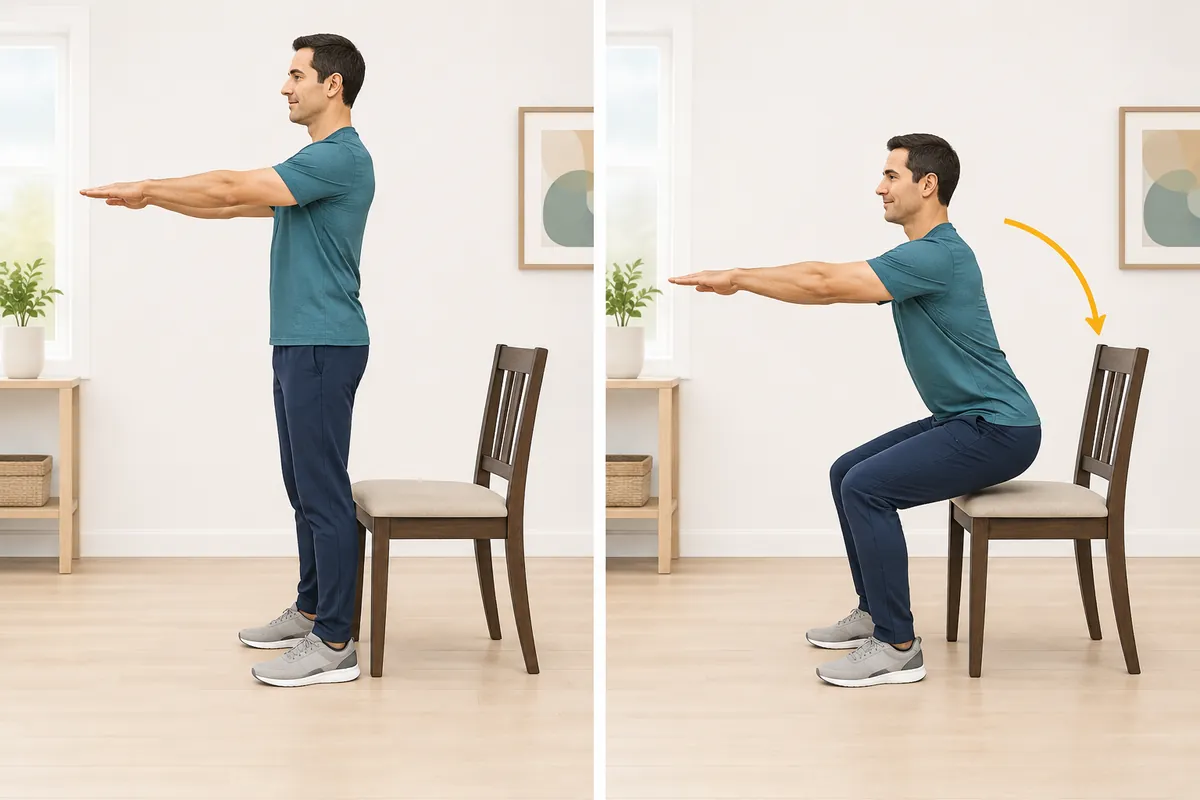
1. Chair Squat
What it works
Chair squats primarily train the thighs and hips while teaching the basic squat pattern used in many everyday movements.
How to perform it
First, stand in front of a sturdy chair with your feet around hip-to-shoulder width apart.
Then, reach your hips backward and bend your knees as you lower toward the seat.
Touch the chair lightly or sit briefly, then press through your feet to stand again.
Meanwhile, keep the movement controlled rather than dropping onto the chair.
Beginner variation
Hold a stable support with one or both hands.
You can also use a higher chair or perform only a partial squat if a deeper range is currently difficult.
Starting repetitions
Begin with about 6-10 controlled repetitions.
Common mistake
Trying to squat deeper than you can control simply because you think deeper is automatically better.
Stop or modify if…
For example, stop if you experience sharp or increasing pain rather than normal muscular effort.
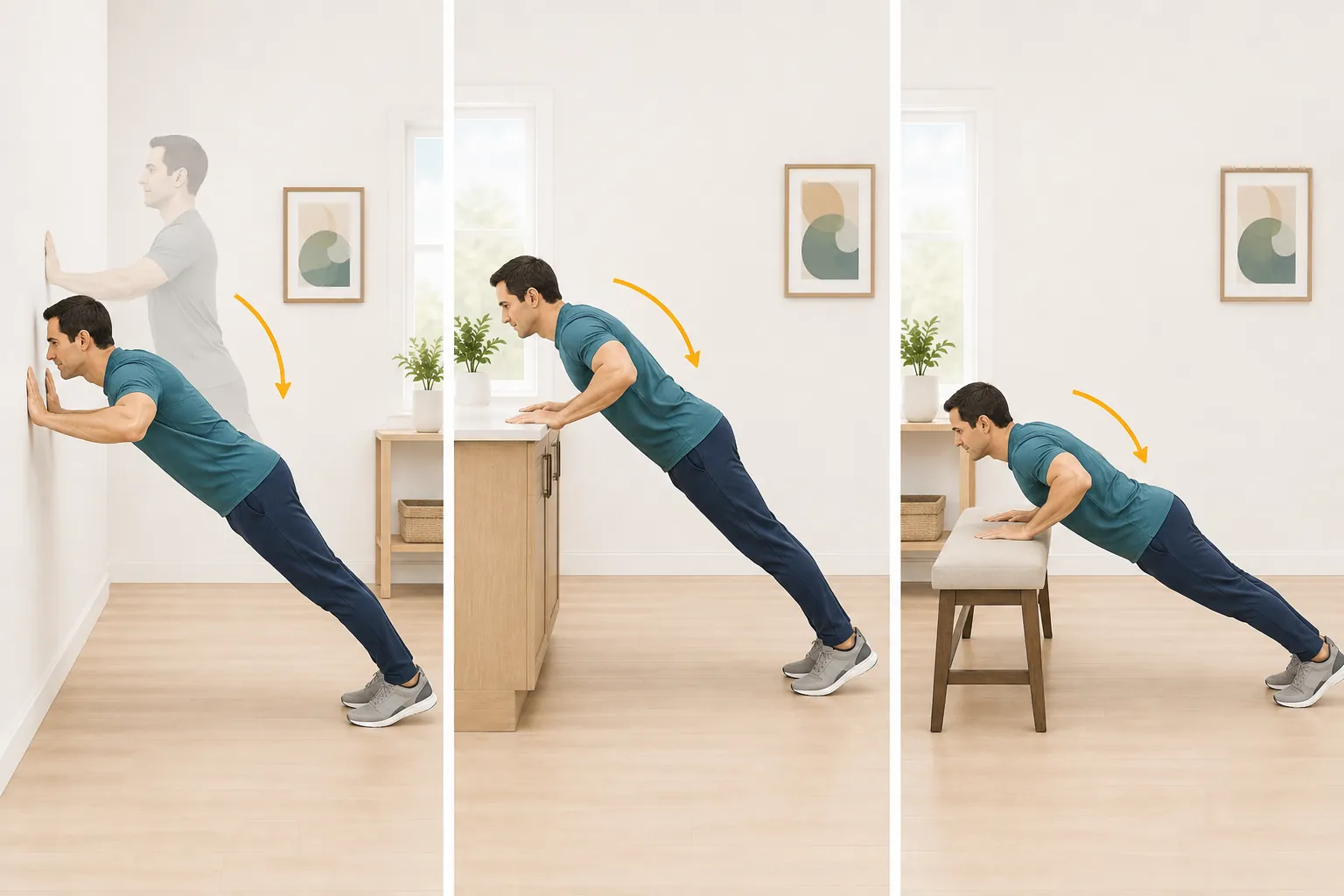
2. Wall or Incline Push-Up
What it works
Push-ups train the chest, shoulders, arms and trunk.
How to perform it
First, place your hands against a wall slightly wider than shoulder width.
Then, walk your feet backward until your body forms a comfortable straight line.
Next, bend your elbows and allow your chest to move toward the wall.
Push the wall away to return to the starting position.
Keep your body controlled instead of letting your hips move independently.
Beginner variation and progression
Use this sequence:
Wall → high stable surface → lower stable surface → floor
As a result, the lower your hands move toward the floor, the more bodyweight you generally have to control.
There is no reason to rush through these stages.
Starting repetitions
Try 6-10 controlled repetitions.
Common mistake
Moving the head toward the wall while leaving the hips behind.
Think about moving your body as one controlled unit.
Stop or modify if…
However, stop if your wrists, shoulders or another area becomes painful, or if you cannot maintain control.
3. Glute Bridge
What it works
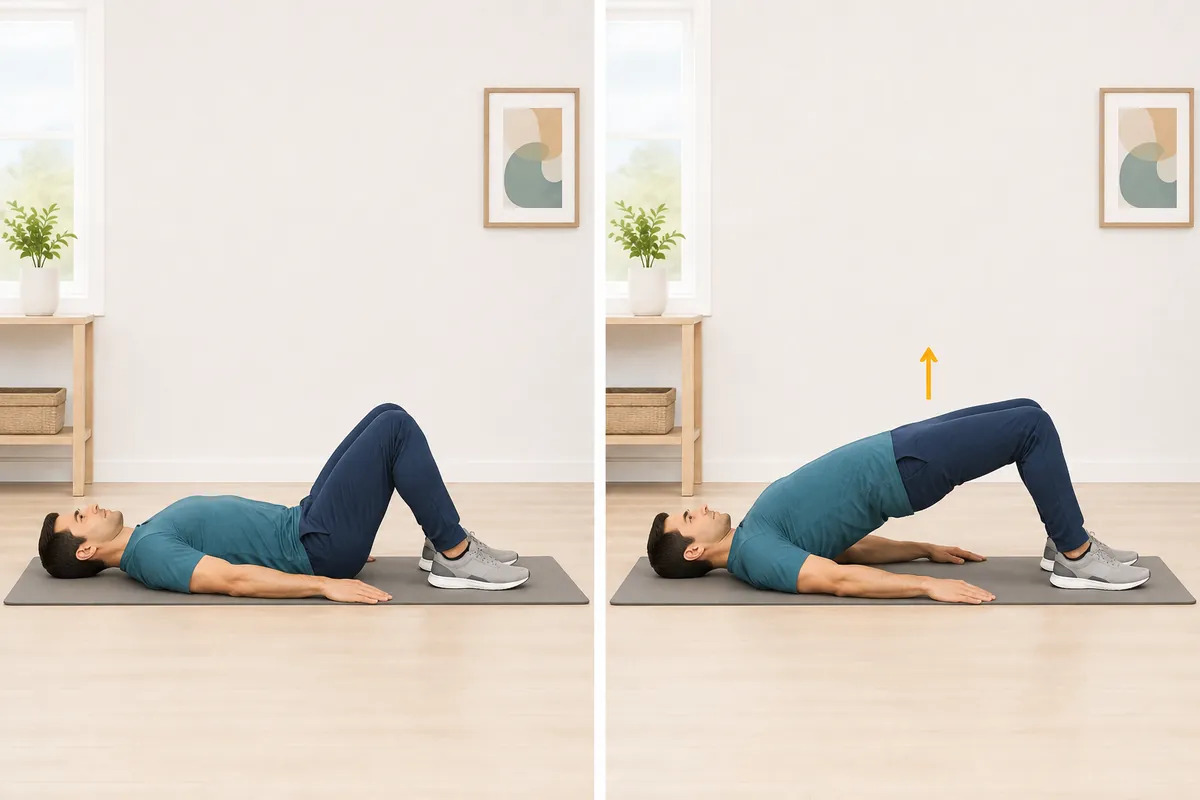
The glute bridge trains the hips and gluteal muscles while introducing controlled hip extension.
How to perform it
First, lie on your back with your knees bent and feet on the floor.
Gently brace your trunk.
Then, press through your feet and lift your hips until you reach a comfortable position.
Pause briefly, then lower slowly.
Beginner variation
Use a smaller range of motion.
You do not have to lift as high as possible.
Starting repetitions
Begin with 8-12 repetitions.
Common mistake
For example, avoid arching the lower back aggressively to create the appearance of a higher bridge.
Instead, the goal is controlled hip movement, not maximum height.
Stop or modify if…
However, stop if the movement causes pain or discomfort that does not improve when you reduce the range.
4. Supported Reverse Lunge or Step-Back Tap
What it works
This movement trains the legs and hips while also challenging balance.
How to perform a supported reverse lunge
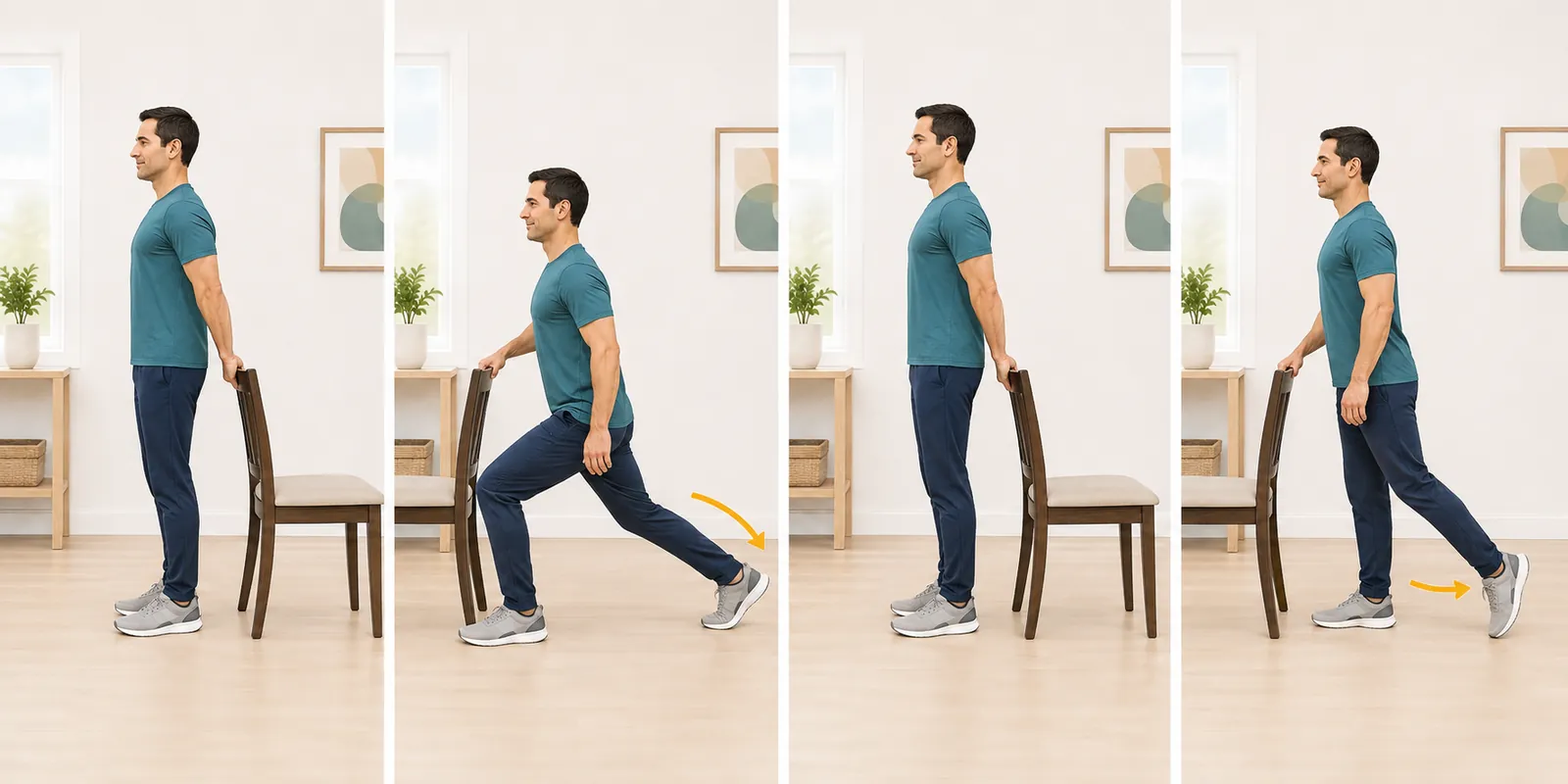
First, stand beside a wall or chair.
Step one foot backward.
Bend both knees slightly while keeping the movement comfortable.
Push through the front foot to return.
Easiest beginner option: step-back tap
If the lunge feels too difficult, simply step one foot backward, tap the floor and return to standing.
Alternate sides.
As a result, this lets you practice the stepping pattern before adding a deeper knee bend.
Starting repetitions
Perform 5-8 repetitions on each side.
Common mistake
For example, avoid taking such a large backward step that balance becomes the entire workout.
Stop or modify if…
You cannot control the movement even while holding support.
5. Bird Dog
What it works
In addition, bird dog trains trunk stability, coordination and control around the hips and shoulders.
How to perform it
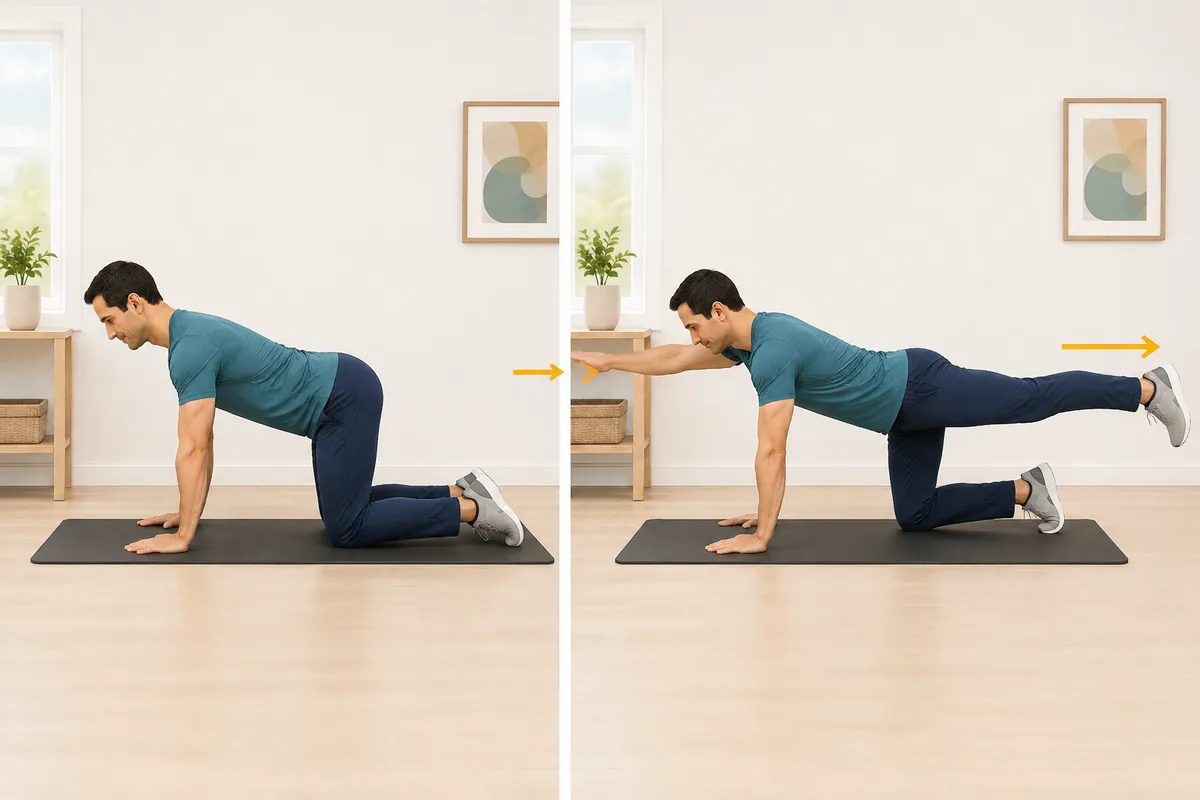
Begin on your hands and knees.
Gently brace your midsection.
Slowly reach one arm forward while extending the opposite leg backward.
Return under control and switch sides.
Beginner variation
Movement does not have to be large.
You can:
- Move only one arm.
- Move only one leg.
- Slide your toes backward along the floor.
- Reach your hand only a few inches forward.
Gradually increase the range as balance improves.
Starting repetitions
Try 5-8 repetitions per side.
Common mistake
Rotating the hips or rushing from side to side.
Stop or modify if…
However, stop if you cannot remain stable despite shortening the movement.
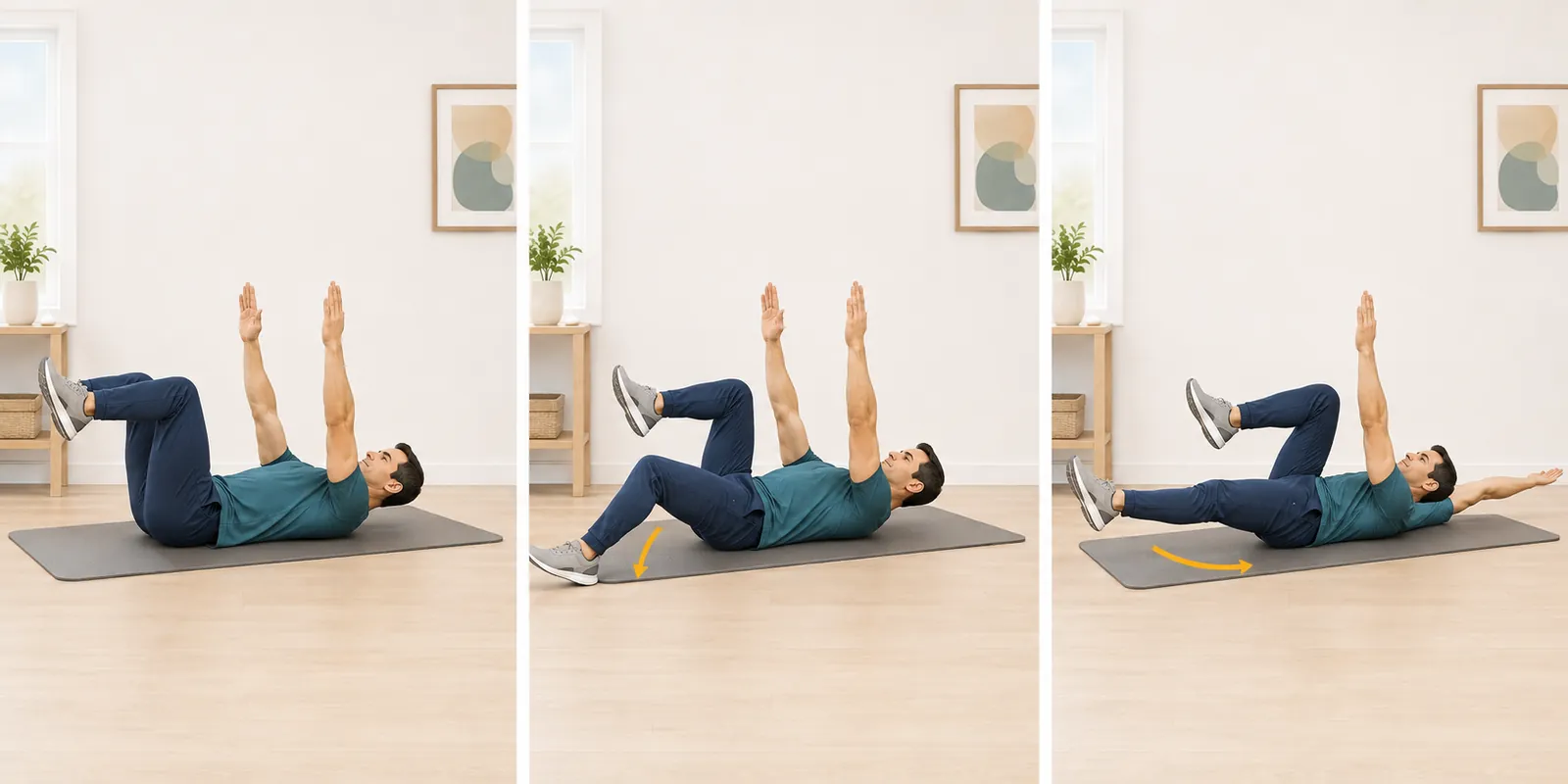
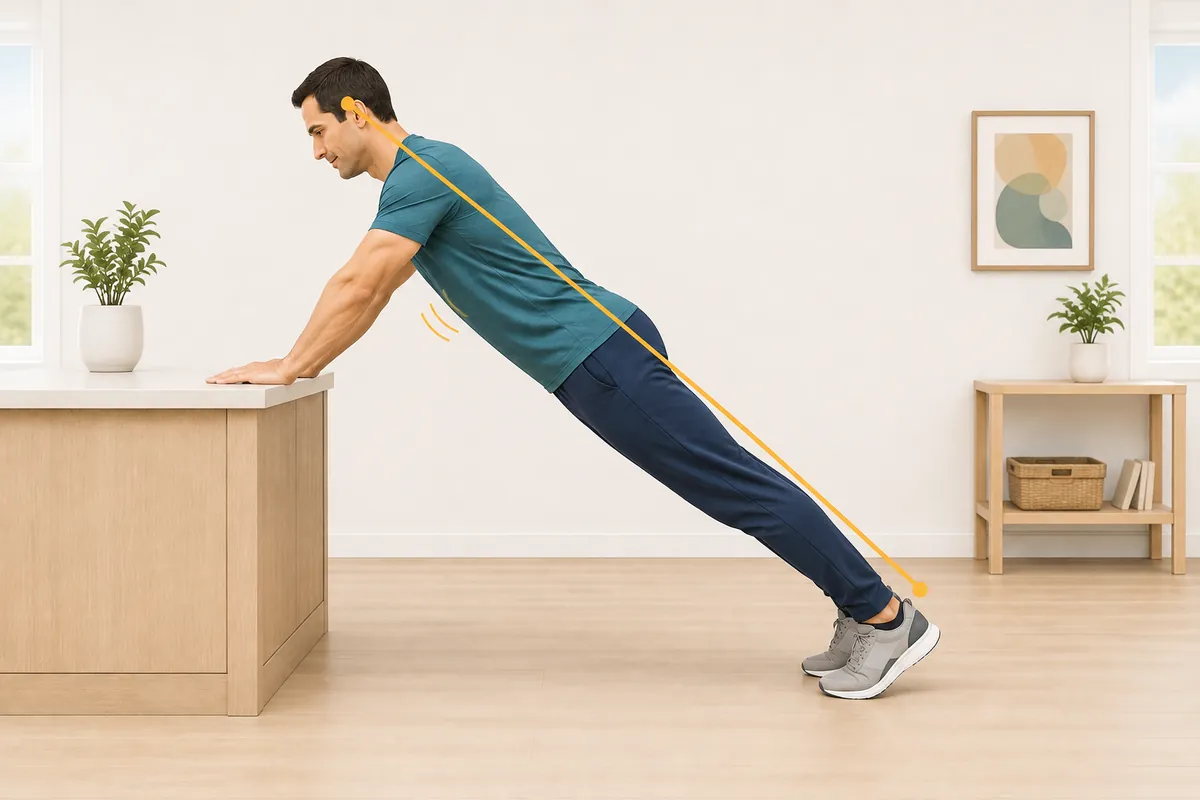
6. Dead Bug or Incline Plank
For example, dead bugs and incline planks are two options for developing basic trunk control.
Dead bug
First, lie on your back with your arms pointing toward the ceiling and your hips and knees comfortably bent to approximately 90 degrees.
Gently brace your abdomen while continuing to breathe. Next, lower one heel toward the floor without allowing your lower back to arch noticeably, then return and alternate sides.
Then, progress to moving one arm and the opposite leg only when you can maintain the same trunk control.
Perform about 5-8 controlled repetitions per side.
Incline plank
Place your hands on a secure high surface.
Next, step backward until your body forms a comfortable straight line.
Hold while breathing normally.
Start with around 10-20 seconds.
Common mistake
However, avoid holding your breath and treating a plank as a test of suffering.
Stop or modify if…
Similarly, stop if the position is uncomfortable or you cannot breathe normally.
Choose the dead bug instead if a plank does not suit you.
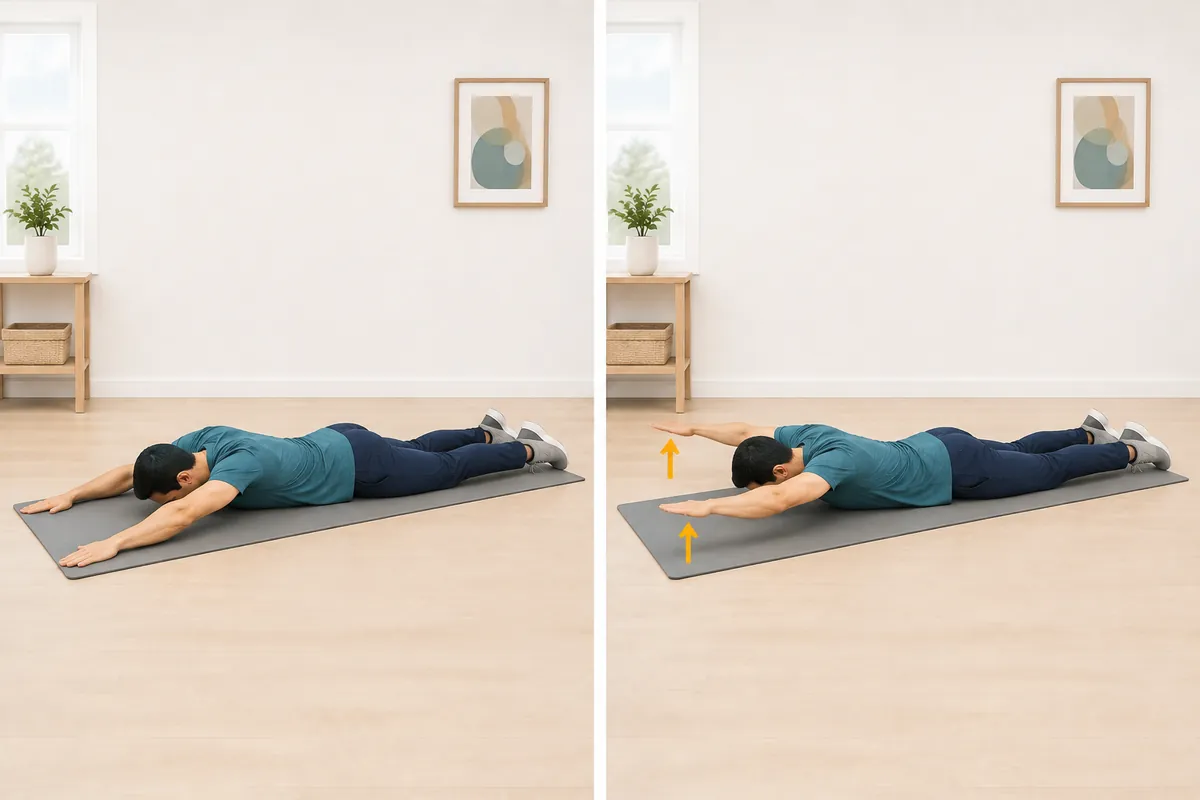
7. Floor Y-Raise
What it works
The floor Y-raise primarily trains muscles involved in upper-back, shoulder-blade and shoulder control. However, it is not a substitute for a true rowing or pulling exercise.
How to perform a floor Y-raise
Lie face down.
Position your arms slightly overhead so your body resembles the letter Y.
Gently lift your hands a small distance from the floor while keeping your neck relaxed.
Lower slowly.
A very small lift is enough.
Beginner variation
For example, keep your hands closer to your body or alternate one arm at a time.
Starting repetitions
Perform 6-10 slow repetitions.
Common mistake
For example, avoid trying to lift the entire chest as high as possible and aggressively arching the back.
Stop or modify if…
The movement causes pain instead of mild muscular effort.
How to Choose the Right Difficulty
In short, a successful beginner workout should challenge you without turning every set into a maximum-effort test.
Use this simple scale.
Too easy
You finish the set and feel as though you could have repeated it many more times with almost no effort.
That does not necessarily make the exercise useless, especially while learning technique, but eventually you will need a little more challenge.
About right
The final few repetitions require concentration, but you still control the movement and could probably perform another good repetition or two.
Therefore, this is an excellent place for a beginner to spend most workouts.
Too difficult
For example, the exercise is too difficult if your technique noticeably changes, you cannot complete the minimum repetitions, you repeatedly hold your breath or you have to throw your body through the movement.
Make the exercise easier.
You do not need to train every set to failure to make progress. In fact, the 2026 American College of Sports Medicine position stand concluded that resistance training improves strength, muscle size, endurance and physical function across a wide range of training prescriptions, while training to momentary failure did not consistently improve outcomes.
Use this progression order
When an exercise becomes easier:
- Improve your technique.
- Add one or two repetitions.
- Add a set.
- Use a slightly more challenging variation.
- Only change one major variable at a time.
For example, do not simultaneously move from wall push-ups to a low incline, double your repetitions and add another set.
In short, progress should make training more challenging, not chaotic.
The 30-Day Calisthenics Workout Plan for Beginners
The program alternates two simple introductory whole-body sessions. As noted above, neither session includes a true pulling exercise.
Workout A
- Chair squat
- Wall or incline push-up
- Glute bridge
- Bird dog
Workout B
- Supported reverse lunge or step-back tap
- Wall or incline push-up
- Dead bug or incline plank
- Floor Y-raise
Notice that push-ups appear in both workouts.
That is intentional. For example, many beginners benefit more from learning the pushing pattern through an easy wall or incline variation than from constantly changing exercises.
Mobility and Recovery Session
For example, on lighter days, choose approximately 10-20 minutes of comfortable activity:
- Easy walking
- Shoulder circles and mobility
- Gentle hip movement
- Comfortable stretching
- Relaxed movement around the house
This should leave you feeling refreshed.
How the workload progresses
| Week | Sets | General target |
|---|---|---|
| Week 1 | 1-2 | Learn every movement |
| Week 2 | 2 | Make the routine consistent |
| Week 3 | 2, occasionally 3 | Add a few repetitions where appropriate |
| Week 4 | 2-3 | Improve control or try one harder variation |
These are starting guidelines, not requirements.
If two sets are plenty in Week 4, continue performing two sets.
Complete 30-Day Schedule
| Day | Session | What to do |
|---|---|---|
| 1 | Workout A | 1 set of each movement. Learn technique. |
| 2 | Light movement | 10-15 minute easy walk plus gentle mobility. |
| 3 | Workout B | 1 set of each movement. Keep variations easy. |
| 4 | Recovery | No structured workout required. |
| 5 | Workout A | 1-2 sets if Day 1 felt comfortable. |
| 6 | Light movement | Easy walking or mobility. |
| 7 | Recovery | Rest and assess how your body feels. |
| 8 | Workout B | Begin Week 2. Aim for 2 controlled sets. |
| 9 | Light movement | 10-20 minutes of comfortable walking or mobility. |
| 10 | Workout A | 2 sets. Add repetitions only if technique remains good. |
| 11 | Recovery | Rest. |
| 12 | Workout B | 2 controlled sets. |
| 13 | Light movement | Easy walk and gentle mobility. |
| 14 | Recovery | Rest. |
| 15 | Workout A | Begin Week 3. Use 2 sets and add 1-2 reps where appropriate. |
| 16 | Light movement | Comfortable walking or mobility. |
| 17 | Workout B | 2 sets. A third set is optional for movements that feel manageable. |
| 18 | Recovery | Rest. |
| 19 | Workout A | 2-3 sets. Prioritize control. |
| 20 | Light movement | Walk or perform gentle mobility. |
| 21 | Recovery | Rest. |
| 22 | Workout B | Begin Week 4. Use 2-3 sets. |
| 23 | Light movement | Easy walking or mobility. |
| 24 | Workout A | Improve repetitions or one exercise variation. |
| 25 | Recovery | Rest. |
| 26 | Workout B | 2-3 controlled sets. |
| 27 | Light movement | Easy walking and mobility. |
| 28 | Recovery | Rest. |
| 29 | Easy preparation | Short walk and gentle mobility. Do not test yourself. |
| 30 | Workout A benchmark | Repeat your original exercises and compare control, confidence and technique with Day 1. |
What should you measure on Day 30?
Not your appearance.
Instead ask:
- Does the squat feel more natural?
- Can you use less support?
- Is your push-up variation smoother?
- Can you perform more controlled repetitions?
- Can you maintain your bird dog position more easily?
- Do you understand your own exercise difficulty better?
- Did you establish a repeatable training habit?
Those changes matter because they give you something you can build on.
This plan is completely free, and if you want a 30-day calisthenics workout plan PDF, you can use your browser’s print function to save this page as a PDF for personal reference.
How Many Sets and Repetitions Should Beginners Do?
In fact, there is no single repetition prescription that every beginner must follow.
Use the following ranges as practical starting points.
| Exercise | Starting option | Repetitions/time | Rest |
|---|---|---|---|
| Chair squat | Supported if required | 6-10 | 45-90 sec |
| Wall push-up | Comfortable wall distance | 6-10 | 45-90 sec |
| Glute bridge | Controlled range | 8-12 | 45-90 sec |
| Step-back tap | Hold support | 5-8 each side | 45-90 sec |
| Bird dog | Short reach if needed | 5-8 each side | 30-60 sec |
| Dead bug | Move one limb at a time | 5-8 each side | 30-60 sec |
| Incline plank | High stable surface | 10-20 sec | 30-60 sec |
| Floor Y-raise | Small comfortable lift | 6-10 | 30-60 sec |
Rest longer if you need it.
Your muscles do not know that somebody on the internet told you your next set must begin exactly 45 seconds later.
In other words, the point of resting is to regain enough control to perform another useful set.
In addition, federal guidance emphasizes gradually building activity and strengthening the major muscle groups rather than forcing everyone into one rigid beginner volume.
What Should You Do If the Plan Feels Too Difficult?
A beginner plan should be adjustable.
Needing to modify it does not mean you have failed the plan. Instead, it means the plan is being adapted to the person actually performing it.
I Cannot Do a Push-Up Yet
Then do not start with a floor push-up.
Use a wall.
When 10 controlled wall push-ups become easy, move your feet slightly farther away or progress to a secure high surface.
Later, gradually lower the incline.
Your first successful push-up does not have to happen on Day 1 or even Day 30.
My Legs Are Very Sore
Mild muscle soreness after a new exercise can occur, particularly during the first few sessions. For example, delayed onset muscle soreness commonly begins 12-24 hours after unfamiliar exercise and may be greatest around 24-72 hours afterward. See ACSM guidance on delayed onset muscle soreness.
If your legs simply feel mildly sore or stiff, an easy walk and additional recovery may be reasonable.
If pain is severe, worsening, associated with significant swelling or weakness, follows an obvious injury, or makes normal movement difficult, do not assume it is ordinary workout soreness.
I Missed Several Days
Do not perform three missed workouts tomorrow.
Resume from the last week you completed comfortably.
If you stopped midway through Week 2 for several days, you can simply restart Week 2.
Fitness plans should accommodate real life.
I Cannot Complete All the Repetitions
Reduce something.
You can:
- Perform fewer repetitions.
- Shorten the range of motion.
- Use more support.
- Choose an easier variation.
- Perform one set instead of two.
For example, five controlled repetitions are more useful than ten repetitions that fall apart halfway through.
Thirty Days Is Not Enough for Me to Progress
Repeat a week.
There is no physiological rule saying your body must unlock the next exercise because seven calendar days have passed.
If wall push-ups are still appropriately challenging, keep doing wall push-ups.
What if the workout feels too easy?
Progress only one thing.
For example:
- Add two repetitions to your chair squat, or
- Add a second set, or
- Use slightly less assistance.
Do not change everything at once.
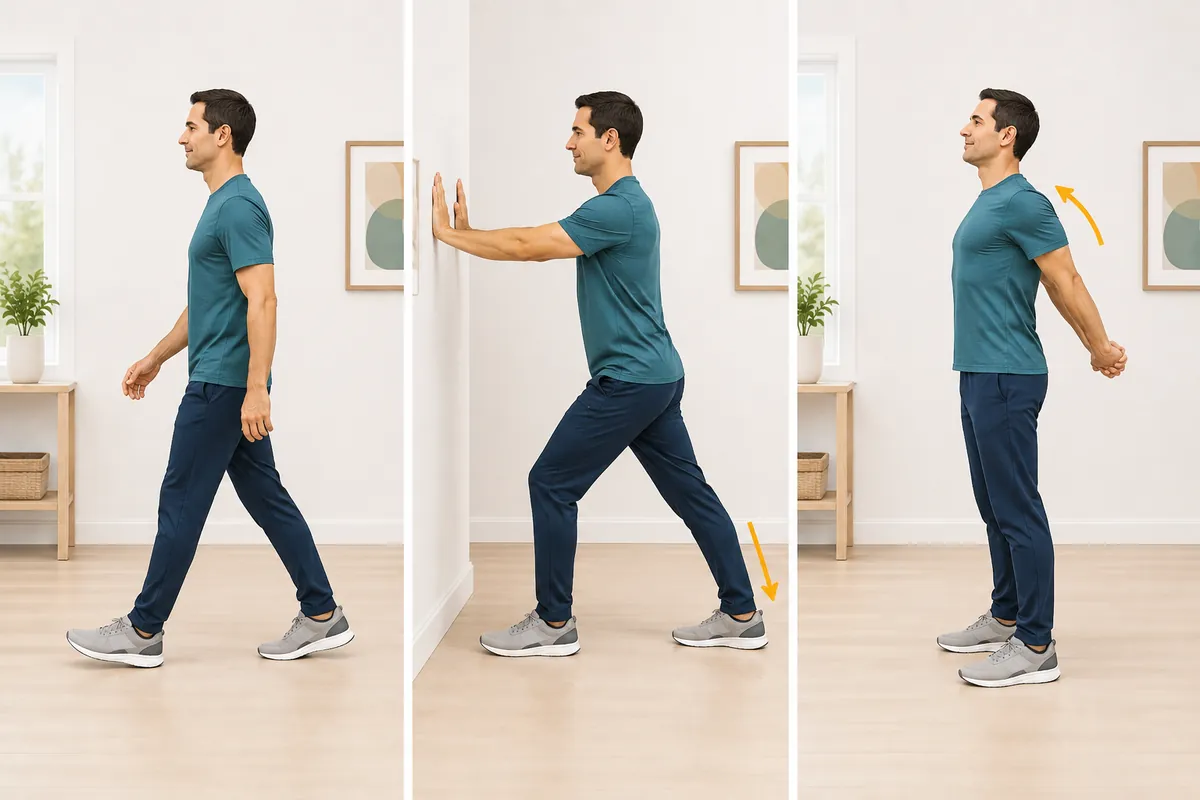
How to Cool Down After the Workout
In fact, you do not need an elaborate 20-minute flexibility routine.
Then, take about three to five minutes to transition from training back to normal activity.
Try:
- Slow walking around the room
- Relaxed breathing
- Gentle calf stretch
- Comfortable chest and shoulder movement
- Gentle hip stretch
None of these should be forced.
What Results Can You Expect After 30 Days?
Thirty days is enough time to learn.
However, it is not enough time to promise a completely different body.
Realistic improvements may include:
- Better understanding of fundamental movements
- Greater workout consistency
- Improved coordination
- Better movement control
- More repetitions at the same variation
- Progression to a slightly harder variation
- Better tolerance for short workouts
- More confidence exercising at home
- A clearer understanding of what feels easy, appropriate and too difficult
For example, you might notice physical changes, but nobody can responsibly guarantee visible muscle gain, a certain amount of weight loss or a dramatic “30-day transformation.”
The strongest result from your first month may simply be that exercise stops feeling unfamiliar.
What about calisthenics results after one month versus one year?
One month is primarily an introduction.
Over time, a year of consistent and progressive training gives you enough opportunity to build substantially beyond these beginner movements. Over time, you may progress toward floor push-ups, split squats, deeper squat variations, rows, pull-ups, dips and more advanced trunk exercises depending on your goals, equipment and ability.
However, the mistake is comparing Month 1 with somebody else’s Year 5.
Can Calisthenics Help With Weight Loss?
However, this 30-day routine cannot guarantee weight loss even though calisthenics can contribute to a weight-management program.
In addition, bodyweight workouts use energy and can improve strength and muscular fitness. In addition, resistance training can support muscular fitness while weight is being managed.
However, a calisthenics workout does not override overall energy balance.
CDC guidance notes that physical activity increases energy expenditure, while weight loss generally requires an overall calorie deficit.
In other words, the answer to “What is the best calisthenics workout for weight loss?” is not simply “do more burpees.”
A sustainable approach usually includes:
- Regular strength training
- Walking or another aerobic activity
- A sustainable eating pattern
- Enough recovery
- Consistency over time
Does calisthenics burn belly fat?
Calisthenics can contribute to overall fat loss when it is part of an appropriate activity and nutrition pattern. For example, exercise programs can reduce abdominal fat on average, although the effect varies by the person and program. See this systematic review of 84 randomized trials.
What you should not expect is to perform abdominal exercises and precisely choose where visible body fat disappears first.
Train your core because it helps you become stronger and control your body, not because somebody promises that 100 crunches will selectively erase belly fat.
Calisthenics vs Gym: Which Is Better?
Neither is universally better.
They are tools.
| Goal | Calisthenics | Gym resistance training |
|---|---|---|
| Start exercising cheaply | Excellent | Requires access/equipment |
| Train at home | Excellent | Possible with home weights |
| Learn body control | Excellent | Good |
| Precisely increase resistance | Harder | Excellent |
| Train back/pulling without equipment | Limited | Easier |
| Maximum-load strength training | More difficult at advanced levels | Easier |
| Build muscle | Possible | Possible |
| Exercise while travelling | Excellent | Depends on gym access |
The 2026 ACSM review found that resistance training improves strength and muscle growth across many different program designs and that equipment type by itself did not consistently determine results. For example, heavier resistance is particularly useful when maximal strength is the priority, while higher weekly training volume becomes more important for muscle growth.
Which is better for strength?
For a complete beginner, either can build strength.
Calisthenics makes it easy to begin because resistance can often be modified by changing body position.
As you become more advanced, weights make loading very precise. For example, adding 2.5 kilograms to a lift is simpler than inventing the perfect bodyweight progression for every muscle group.
Which is better for muscle gain?
In fact, both can stimulate muscle growth when the muscles receive sufficient progressive resistance.
Gym training can make progression easier because you can adjust weight in small increments and target individual muscle groups more easily.
That does not make bodyweight training ineffective.
Can you combine calisthenics and gym training?
Absolutely.
You might perform:
- Push-ups and bench press
- Pull-ups and cable rows
- Bodyweight split squats and weighted squats
- Planks and loaded carries
As a result, combining fitness methods becomes straightforward once you stop treating them like competing sports teams.
What is the difference between calisthenics and gymnastics?
They overlap, but they are not the same thing.
Calisthenics is a broad form of bodyweight resistance training used for fitness, strength and physical skills.
Gymnastics is an organized sport involving specialized techniques, events and apparatus such as rings, bars, beam, floor and vault.
For example, a handstand may appear in both, but doing calisthenics does not automatically mean you are training as a gymnast.
Does Calisthenics Change for Women, Pregnancy or Older Beginners?
Do women need a different beginner calisthenics workout?
For most healthy adults, basic exercise selection does not need to be divided into a “male plan” and “female plan.”
A chair squat remains a chair squat.
The more useful variables are:
- Current strength
- Experience
- Mobility
- Injury history
- Goals
- Recovery
- Appropriate exercise difficulty
For example, a female beginner who can perform 12 incline push-ups may reasonably start at a harder variation than a male beginner who currently needs wall push-ups.
Train the person, not the search term.
What about calisthenics during pregnancy?
This generic program was not designed as a prenatal or postpartum workout. Pregnancy and postpartum exercise may require individualized modifications.
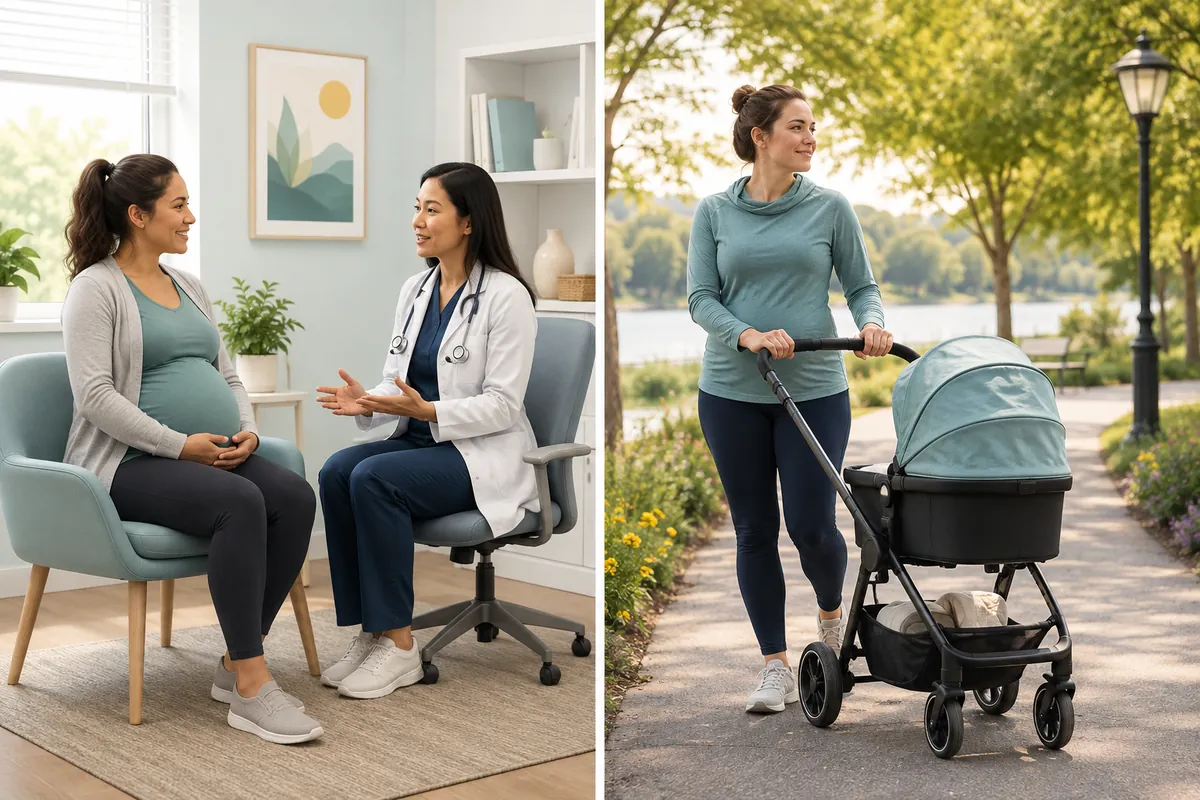
During pregnancy, exercise may require individual modification as it progresses.
ACOG states that exercise is generally safe and beneficial for people with uncomplicated pregnancies, but recommends clinical evaluation and appropriate adjustment when medical or obstetric complications exist.
A generic 30-day internet plan should therefore not replace individualized pregnancy guidance.
If you are pregnant, discuss your intended exercise with your obstetric healthcare professional and use pregnancy-appropriate modifications.
What about calisthenics after pregnancy or a C-section?
Returning to exercise after childbirth depends on the delivery, recovery and presence of complications.
Accordingly, ACOG advises a gradual return when medically safe and specifically notes that timing can differ after cesarean birth or complications.
Therefore, do not use an arbitrary internet timeline after a C-section.
Get individualized clearance and rebuild gradually.
Can you start calisthenics after 35, 40 or 50?
Yes. However, turning 35, 40 or 50 does not suddenly make bodyweight exercise inappropriate.
Therefore, the starting variation simply needs to match your current capability.
If you are returning after years of inactivity, you may want to:
- Use more support.
- Begin with one set.
- Progress more slowly.
- Allow additional recovery.
- Add balance practice if useful.
- Spend longer learning technique.
In addition, for adults 65 and older, CDC guidance specifically recommends a combination of aerobic, muscle-strengthening and balance activities.
In short, the principle remains the same: begin from what you can control today.
Frequently Asked Questions
Can complete beginners start calisthenics?
Yes. Calisthenics does not begin with pull-ups, dips and handstands. For example, a complete beginner can start with wall push-ups, chair squats, glute bridges and supported movements. However, the important step is choosing a variation you can control. If an exercise requires you to struggle through every repetition, make it easier rather than assuming calisthenics is too advanced for you.
Can I do calisthenics if I cannot perform one push-up?
Yes. First, start with wall push-ups. As they become easier, progress toward a secure high incline, then gradually use lower surfaces. Floor push-ups are a later progression, not an entry requirement. There is no benefit in repeatedly failing floor push-ups when an easier variation would let you practice the same basic pushing movement productively.
Is 20 minutes of calisthenics enough for a beginner?
Twenty minutes can be a useful beginner strength session. However, the quality and consistency of the session matter more than making every workout long. For example, a short session containing several controlled movements can provide meaningful practice and resistance training. Still, it does not, by itself, replace the recommended weekly aerobic activity. U.S. guidance advises adults to work toward at least 150 minutes of moderate aerobic activity weekly, plus muscle-strengthening activity on two or more days. See the CDC adult activity guidance.
Should beginners do calisthenics every day?
You can move every day, but that does not mean every day should be a demanding strength workout. Therefore, this plan deliberately alternates strength, light activity and recovery. In addition, muscles need both training and time to recover. Beginners also benefit from arriving at the next workout fresh enough to practice good technique rather than accumulating fatigue simply to maintain a daily streak.
What should I do on recovery days?
Recovery days can be completely restful, or you can perform comfortable activity such as walking and gentle mobility. However, do not secretly convert every recovery day into another hard workout. If you enjoy walking, that is an excellent way to remain active while giving the muscles used in your strength session a break.
Can I repeat this 30-day plan?
Yes. In fact, repeating the program may be smarter than immediately switching to a harder plan. Then, on your second cycle, you can gradually use slightly more repetitions, another set or a harder variation where appropriate. Moreover, repeating a plan makes progress easier to notice because you are comparing familiar exercises instead of constantly changing your routine.
Do I need equipment for beginner calisthenics?
Very little. This plan uses a wall, sturdy chair and floor. A mat is optional. As your training progresses, a resistance band and appropriate anchor can be useful because beginner bodyweight programs often lack convenient pulling movements. Eventually you may also choose a pull-up bar or gym, but none of those purchases are necessary for your first month.
When should I move to a harder exercise variation?
Progress when your current version feels controlled across your planned sets and repetitions. Also, technique should remain steady through the final repetition. Next, move only one step at a time. For example, progress from a wall push-up to a high incline instead of immediately attempting floor push-ups. If the harder version destroys your form, return to the easier one and continue building strength.
Is there a separate 30-day calisthenics workout plan for men and women?
In fact, most beginners do not need sex-specific versions of these basic movements. Instead, exercise difficulty should be selected according to individual ability. Pregnancy, postpartum recovery, certain medical conditions or specific performance goals can require modifications, but an ordinary healthy beginner should usually choose exercises according to strength, technique and comfort rather than selecting a plan solely because it is labelled male or female.
Can calisthenics and gym workouts be done together?
Yes. In fact, calisthenics and traditional resistance training complement each other very well. For example, you can use push-ups, pull-ups, dips and bodyweight core work alongside dumbbells, barbells or machines. However, gym equipment becomes especially useful when you want precise load progression or convenient pulling and lower-body resistance. You do not have to permanently choose one training identity.
Can I do calisthenics after waking up?
Yes, if morning training suits you. First, give yourself a few minutes to become alert and perform the warm-up rather than starting immediately with your hardest exercise. Some people feel stiff first thing in the morning, so begin gradually and judge the session by how your body actually feels rather than assuming morning workouts must be more intense.
Can I do calisthenics after running?
However, you can combine them, and beginners usually do better when every session is not exhausting. For example, an easy walk or light run can coexist comfortably with strength training. If you have just completed a demanding run and your legs are fatigued, you may prefer to separate your strength session or reduce its difficulty. When strength is your main goal, perform the strength work while you are still reasonably fresh.
Can I do calisthenics after eating?
In fact, there is no single waiting period that fits every person and every meal. For example, a small snack and a large meal do not affect comfort in the same way. Therefore, avoid beginning a demanding workout while you still feel very full, nauseated or uncomfortable. For a short beginner session, use your own digestive comfort as the practical guide rather than forcing yourself to train because a timer says you can.
Do I need a calisthenics app, book or YouTube program?
No. However, they can be useful for demonstrations, tracking and variety, but they are optional. Instead, a beginner needs a small number of appropriate exercises, a progression method and consistency more than another subscription. If you use videos, compare the exercises with your current ability instead of copying an advanced creator’s workout simply because it has “beginner” in the title.
How can I get fast results from calisthenics?
Ultimately, the fastest useful approach is usually the least dramatic one: train consistently, use appropriate variations, improve technique, progress gradually and recover adequately. By contrast, trying to accelerate the process by doubling workouts or constantly training to failure can interfere with technique and recovery. Ultimately, the goal of your first month is to create momentum you can continue using after Day 30.
What to Do After Completing the Plan
In other words, finishing Day 30 does not mean you have finished calisthenics.
It means you now have enough experience to make your next decision intelligently.
Option 1: Repeat the plan with slightly harder variations
This is ideal if the structure worked well for you.
Possible progressions include:
- Less assistance during squats
- Lower incline for push-ups
- Deeper supported reverse lunges
- Longer controlled planks
- Larger bird dog range
- Additional repetitions or one extra set
Do not make every exercise harder at once.
Option 2: Progress to a three-day full-body program
You can keep training three days per week while expanding your exercise library.
A future routine might include:
- Squat or split squat
- Push-up progression
- Hip-dominant movement
- Row or pull
- Core stability exercise
- Upper-back movement
At this stage, programming becomes more balanced because you can introduce a true pulling movement.
Option 3: Add a resistance band
A resistance band is one of the most useful inexpensive upgrades after a bodyweight-only beginner program.
It can help you introduce exercises for muscles that are awkward to train with beginner-level bodyweight movements, particularly pulling movements for the upper back and arms.
Therefore, follow the equipment manufacturer’s instructions and use an appropriate secure setup rather than improvising with unstable furniture.
Your next goal should be small enough to repeat
However, you do not need to go from wall push-ups to handstand push-ups.
A useful next goal might simply be:
“For the next month, I will complete three strength sessions most weeks and progress one exercise when it becomes clearly easier.”
As a result, a 30-day challenge can become an actual training habit.
Continue building a sustainable routine: Read our guide to How to Build a Healthy Daily Routine You Can Actually Maintain.
Final Takeaway
In short, calisthenics becomes much easier to understand when you stop thinking of it as a collection of impressive tricks.
In other words, it is resistance training using your body.
The basic pattern is simple: squat, push and stabilize. Later, you can add pulling, carrying, hanging, balancing and more demanding skills.
However, the beginner’s job is not to perform the most advanced version.
Instead, the goal is to find the easiest version that is challenging enough to practice well, repeat it consistently and make it slightly more demanding when the body is ready.
During these 30 days, pay attention to control, confidence and consistency.
If you finish the month understanding how to choose an exercise variation, how to recognize an appropriate effort level, how to recover and how to progress without rushing, you have learned something far more useful than simply surviving a 30-day challenge.
Evidence and Further Reading
- CDC adult physical activity recommendations Adult Activity: An Overview
- U.S. Office of Disease Prevention and Health Promotion activity guidance Move Your Way Activity Planner
- American College of Sports Medicine 2026 resistance training position stand ACSM Resistance Training Position Stand
- ACOG guidance on exercise during pregnancy Exercise During Pregnancy
- ACOG guidance on exercise after pregnancy Exercise After Pregnancy

